The D sus4 Chord Explained
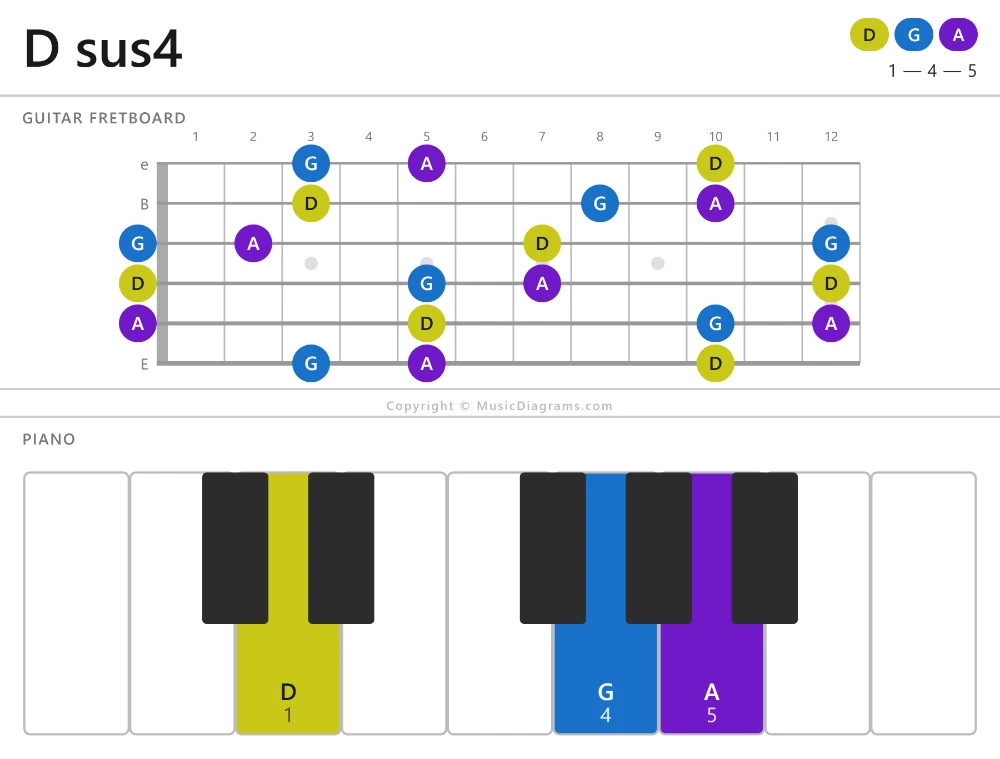
D suspended fourth is a Suspended chord built from the notes D, G, and A. Its root is D, and its interval number formula is 1-4-5, which gives you the interval names root, perfect fourth, and perfect fifth. Because the third is replaced by the fourth, the chord does not sound clearly major or minor. You may also see it written as D sus4, Dsus4, or plain-text spelling D suspended fourth. If you are new to chords, the widget above can help you see and hear how these notes fit together, and this is easier to understand once you learn more about chord intervals.
D sus4 Alternate Names
- D sus4
- Dsus4
- D suspended fourth
D sus4 Chord Notes
D sus4 Chord Formula
D sus4 Chord Notation
How To Use D sus4 In Music
Often, D sus4 has an open, unresolved, and slightly expectant sound because the G seems to want to move to F-sharp in a D major chord or to F in a D minor context. That makes it useful for adding tension and motion without sounding harsh. You might hear it used as a decoration before a D major chord, such as Dsus4-D, or inside progressions like G-I-V in the key of D, where I is Dsus4 resolving to D, or V–I with A moving to Dsus4 and then D. The chords around it strongly affect its mood: next to bright major chords it can sound uplifting and spacious, while beside darker harmony it can feel more dramatic. If you want a broader beginner-friendly overview, see what is a chord.
D sus4 Chord Inversions
Another helpful idea is inversion, which means playing the same chord with a note other than D in the bass. For D sus4, root position is D-G-A, first inversion is G-A-D, and second inversion is A-D-G. Inversions do not change the chord name family, but they do change the weight and color of the sound. A G bass can make the chord feel softer or more floating, while an A bass can make it feel more stable or more connected to a coming resolution. Players use inversions to create smoother bass lines, make chord changes easier, and shape the mood of a progression without changing the basic suspended quality of the chord.