The E 11 Chord Explained
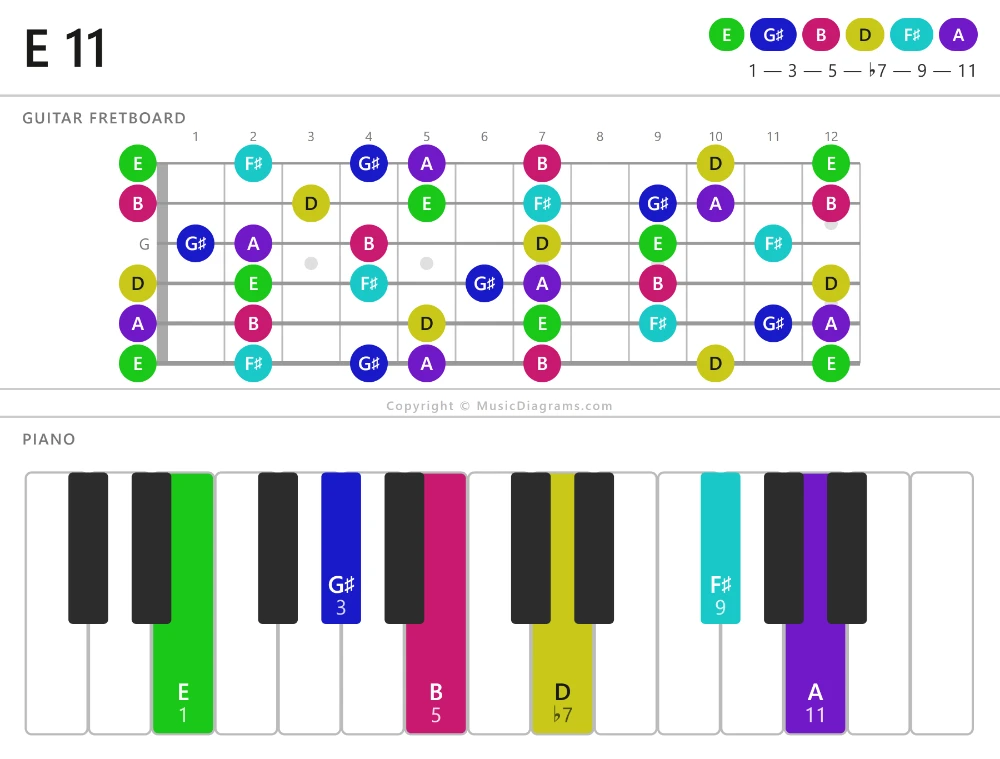
E eleven is a chord in the Dominant family. It uses the notes E, G♯, B, D, F♯, and A. The root is E, and its interval number formula is 1–3–5–♭7–9–11. These intervals are called the root, major third, perfect fifth, minor seventh, major ninth, and perfect eleventh. You may also see it written as E11, E dominant 11, or E7(11). If you look at the widget above, you can match these notes on the piano and guitar diagrams while learning how each chord tone relates to the chord root.
E 11 Alternate Names
- E11
- E dominant 11
- E7(11)
E 11 Chord Notes
E 11 Chord Formula
E 11 Chord Notation
How To Use E 11 In Music
Because it includes both the strong pull of a dominant seventh chord and the added color of the 9th and 11th, E11 sounds rich, tense, open, and slightly bluesy. It often creates motion that wants to resolve to a more stable chord, especially A or A major in the key of A. For example, you might hear E11 used as V in a progression like ii–V–I, or in a bluesy move such as I–IV–V. In the key of A major, that could mean Bm7–E11–Amaj7. The chords around it can change its mood: after softer chords it can sound dramatic, while next to other extended chords it can feel smooth and jazzy. If you are new to chord building, this is also a great example of how stacked tones expand a dominant chord.
E 11 Chord Inversions
Inversions happen when a note other than the root is the lowest note. For E11, root position has E in the bass, but an inversion could place G♯, B, D, F♯, or A at the bottom instead. For instance, an E11/G♯ inversion can sound a little smoother and more connected when moving from or to nearby chords, while E11/D can emphasize the seventh and make the chord feel more unsettled. Players also use practical variations such as leaving out the 5th, or sometimes even the 9th, to make the chord easier to play while keeping its dominant color. These choices can subtly change the weight, brightness, or tension of the chord, which is why inversions and simplified voicings are useful in real music.