The E 7♭9 Chord Explained
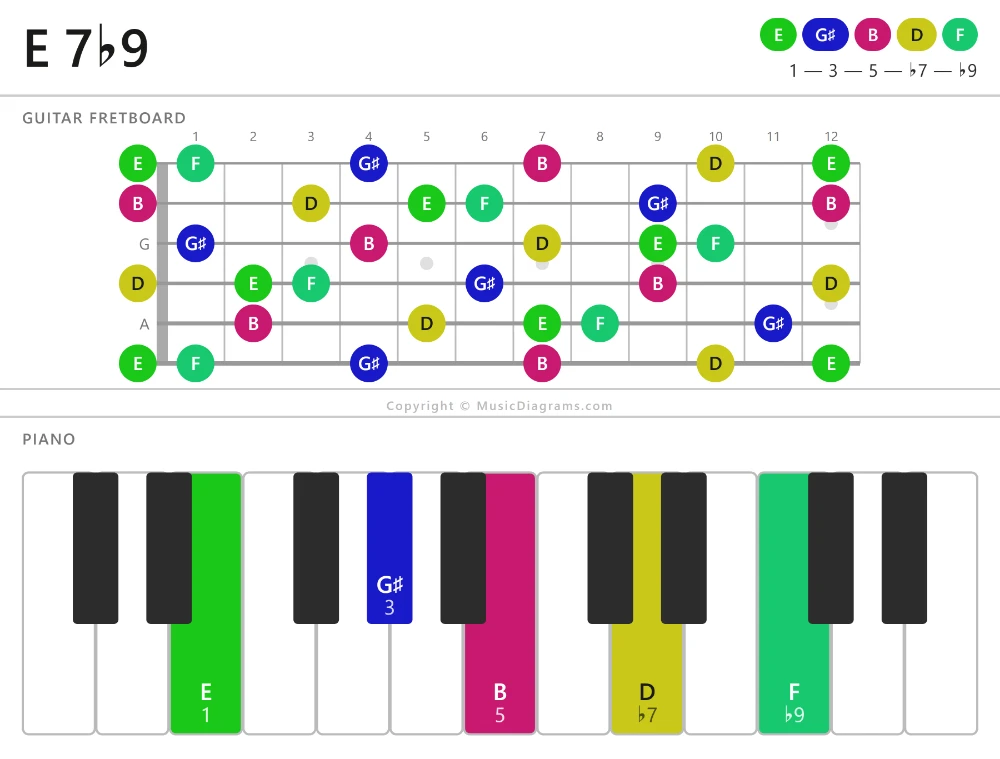
E seven flat nine is a Dominant chord family chord built from the notes E, G♯, B, D, and F. Its root is E, and its interval number formula is 1–3–5–♭7–♭9, which gives you the interval names root, major third, perfect fifth, minor seventh, and minor ninth. You may also see it written as E7♭9, E dominant seventh flat ninth, or E seven flat nine. If you look at the widget above, you can use the piano and guitar diagrams to spot these notes clearly, and the tones help you hear how each chord member contributes to the full sound. To understand how these note distances create the chord, see understanding chord intervals.
E 7♭9 Alternate Names
- E7♭9
- E dominant seventh flat ninth
- E seven flat nine
E 7♭9 Chord Notes
E 7♭9 Chord Formula
E 7♭9 Chord Notation
How To Use E 7♭9 In Music
Because E7♭9 contains both the strong pull of a dominant seventh chord and the extra tension of a flat ninth, it sounds tense, dramatic, and unresolved. Beginners often hear it as a chord that wants to move somewhere else, usually to a more stable chord such as A minor or A major. In progressions, it often works as the V chord leading to i or I, such as Bm7–E7♭9–Am, or ii–V–i in A minor. It can also appear in jazz, flamenco, blues, and classical-influenced harmony when a composer wants extra color before a resolution. The mood of E7♭9 can feel darker or sharper depending on the chords around it; after softer chords it can sound surprising, while after other tense chords it can feel like part of a longer buildup. If you want a clearer sense of why this chord functions so strongly, read what is a dominant chord.
E 7♭9 Chord Inversions
Another useful idea for beginners is inversion, which means the notes of the chord are rearranged so a note other than the root is the lowest note. For E7♭9 in root position, E is the lowest note, but inversions could place G♯, B, D, or even F in the bass. For example, E7♭9/G♯, E7♭9/B, and E7♭9/D each keep the same basic chord identity while changing the weight and color of the sound. Inversions can make the chord feel smoother between surrounding chords, help the bass line move step by step, or emphasize either brightness, instability, or suspense. Players and composers use them to create better voice leading and to make a progression sound less jumpy, even though the chord itself is still recognized as E7♭9.