The E aug7 Chord Explained
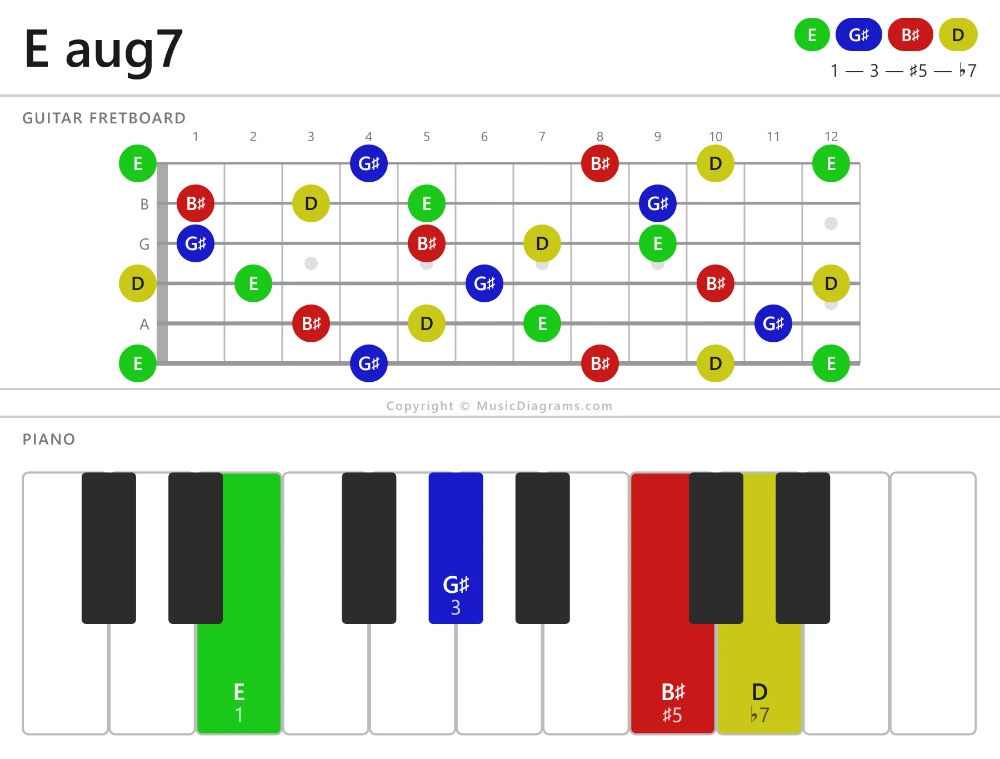
E augmented seventh is an Augmented chord family chord built from the notes E, G♯, B♯, and D. Its root is E, and its interval number formula is 1–3–♯5–♭7, which gives you the interval names root, major third, augmented fifth, and minor seventh. You may also see it written as E aug7, E+7, or E7♯5. If you look at the widget above, you can use the piano and guitar diagrams to spot these chord tones clearly, and hearing them together can help you recognize how this color comes from combining a major sound with a raised fifth. For a beginner-friendly look at how these distances are counted, see understanding chord intervals.
E aug7 Alternate Names
- E aug7
- E+7
- E7♯5
E aug7 Chord Notes
E aug7 Chord Formula
E aug7 Chord Notation
How To Use E aug7 In Music
Because of its raised fifth and minor seventh, this chord sounds bright, tense, and slightly restless, with a dramatic pull toward another harmony. It often appears as a spicy dominant-type color that wants to resolve, so in the key of A minor you might hear E aug7 functioning as V in a progression like i–iv–V–i, or in A major as iii–vi–ii–V–I when a songwriter wants extra tension before the tonic. The mood can feel exciting, mysterious, jazzy, or theatrical depending on the chords around it: moving from a calmer chord into E aug7 makes the tension stand out more, while resolving it smoothly can make the next chord feel especially satisfying. If you want to compare this pull with related harmony, read more about what is a dominant chord.
E aug7 Chord Inversions
Another useful idea is inversion, which means the notes stay the same but a different chord tone is placed in the bass. For E augmented seventh, root position is E–G♯–B♯–D, while inversions include G♯–B♯–D–E, B♯–D–E–G♯, and D–E–G♯–B♯. These inversions do not change the chord’s name family, but they do change its weight and flow: a third in the bass can sound smoother, an augmented fifth in the bass can sound more unstable, and a minor seventh in the bass can create a strong push into the next chord. Players and composers use inversions to make bass lines more melodic, connect chords with less jumping, and shape the mood of a progression without changing the basic harmonic function.