The E♭ 6/9 Chord Explained
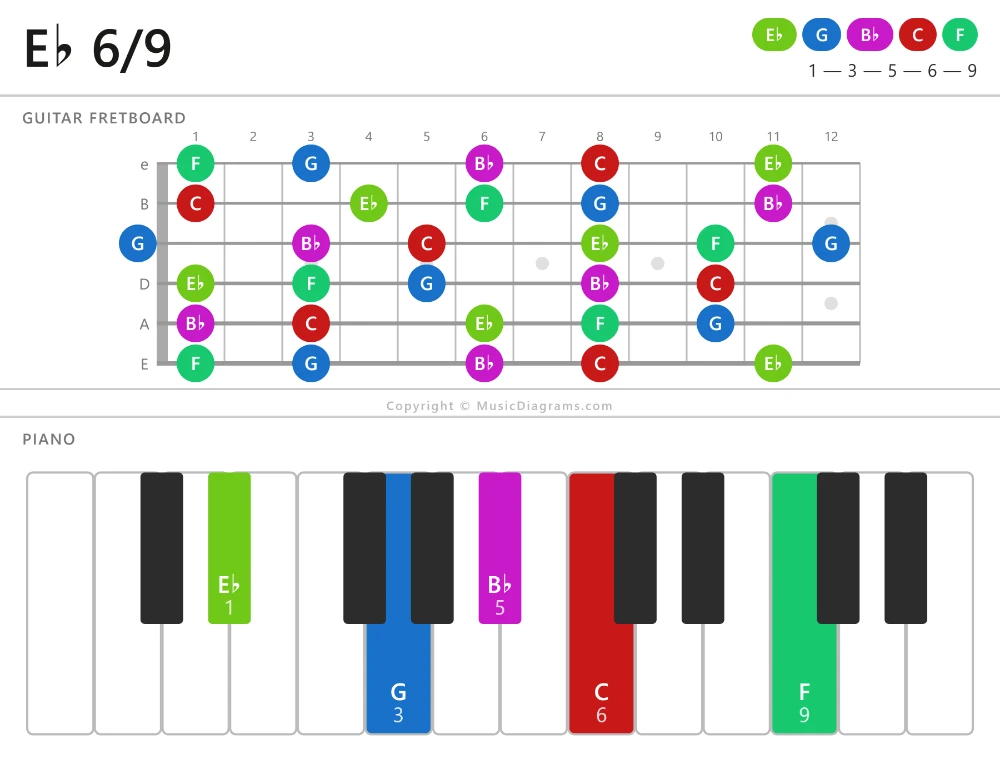
E-flat six-nine is a Major chord family color chord built from the notes E-flat, G, B-flat, C, and F. Its root is E-flat, and its interval number formula is 1-3-5-6-9, which gives you the interval names root, major third, perfect fifth, major sixth, and major ninth. You may also see it written as E-flat 6/9, E-flat major 6/9, or E-flat add 6 add 9. If you look at the widget above, you can use it to visualize where these chord tones sit on piano and guitar, and hearing the notes together can help you recognize how the extra 6th and 9th add warmth and openness beyond a basic major chord. If you are new to chord building, this guide to chord intervals can help make the formula easier to understand.
E♭ 6/9 Alternate Names
- E-flat 6/9
- E-flat major 6/9
- E-flat add 6 add 9
E♭ 6/9 Chord Notes
E♭ 6/9 Chord Formula
E♭ 6/9 Chord Notation
How To Use E♭ 6/9 In Music
Because E-flat 6/9 includes a clear major triad plus two gentle color tones, it usually sounds warm, smooth, bright, and relaxed rather than tense. Beginners often hear it as a richer version of a plain major chord, making it useful in jazz, pop, soul, gospel, film music, and softer acoustic styles. Its mood can change depending on the surrounding harmony: moving from E-flat 6/9 to IV or I can feel settled and peaceful, while placing E-flat 6/9 after a stronger dominant chord can make it sound like a sweet release. For example, in E-flat major you might hear I–vi–ii–V as E-flat 6/9–Cm7–Fm7–B-flat7, or a gentle gospel-style loop such as I–IV–ii–V with E-flat 6/9–A-flat–Fm7–B-flat7. To compare its core sound with a simpler harmony, you can also read about what is a major chord.
E♭ 6/9 Chord Inversions
Another helpful idea for beginners is inversion, which means the chord keeps the same notes but a note other than the root is placed in the bass. For E-flat 6/9 in root position, E-flat is the lowest note, but an inversion might place G in the bass, B-flat in the bass, C in the bass, or F in the bass. These different bass notes can make the chord feel smoother, lighter, or more flowing, especially when connecting one chord to the next. A root-position E-flat 6/9 often feels the most stable, while inversions can sound more delicate or more directional because the ear follows the bass movement. Musicians use inversions to create better voice leading, reduce jumps between chords, and shape the mood of a progression without changing the chord’s overall identity.