The E♭ m13 Chord Explained
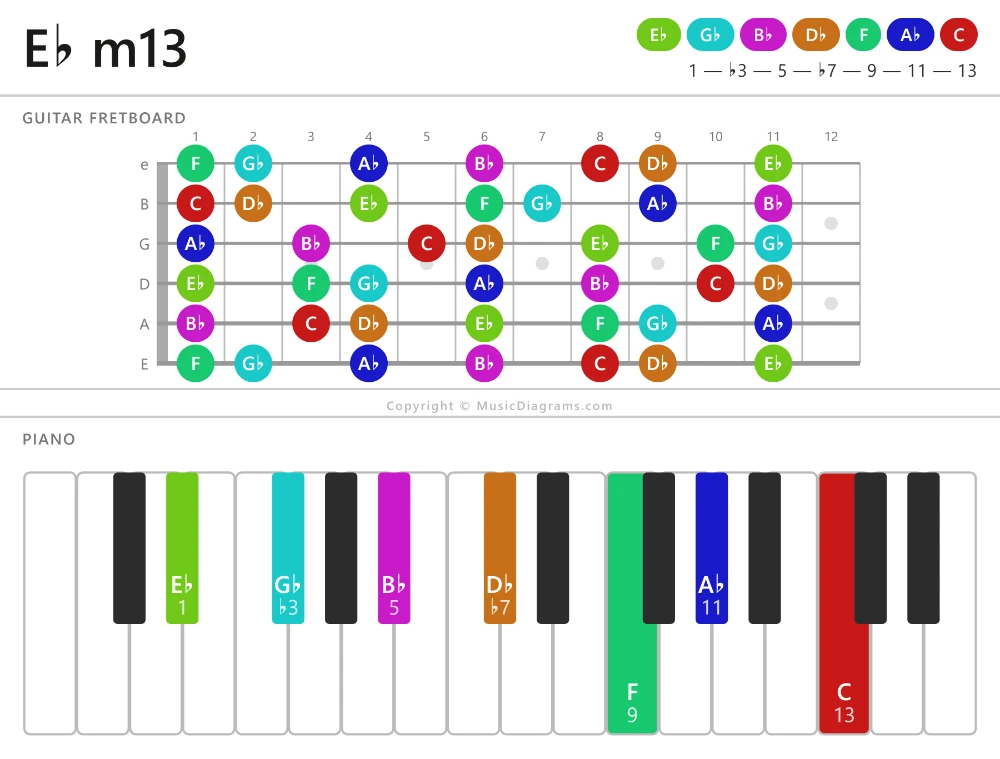
E-flat minor thirteenth is a Half-Diminished-family chord in this guide’s required category system, though in practical music theory it is more specifically a minor extended chord. Its notes are E-flat, G-flat, B-flat, D-flat, F, A-flat, and C. The root is E-flat, and the interval number formula is 1-♭3-5-♭7-9-11-13. Those intervals are called the root, minor third, perfect fifth, minor seventh, major ninth, perfect eleventh, and major thirteenth. You may also see it written as E-flat minor 13, E-flat min13, or E-flat -13. If you look at the widget above, you can use it to see and hear how these chord tones stack together, and you can learn more about chord intervals to understand why this chord has such a rich sound.
E♭ m13 Alternate Names
- E-flat minor 13
- E-flat min13
- E-flat -13
E♭ m13 Chord Notes
E♭ m13 Chord Formula
E♭ m13 Chord Notation
How To Use E♭ m13 In Music
Because it contains seven different chord tones, E-flat minor 13 sounds deep, smooth, jazzy, and emotional, with a darker color than a major chord but more warmth than a plain minor seventh. It can create a soulful, sophisticated mood in jazz, R&B, funk, film music, and neo-soul. The chords around it strongly affect how it feels: it may sound gentle and lush in a progression like i–iv–v in E-flat minor, or more tense and directional when moving toward a dominant harmony such as ii–V–i. For example, E♭m13 might appear as i in E-flat minor, or as ii in a progression like E♭m13–A♭7–D♭maj7. When paired before a brighter chord, its color can feel expressive and longing; when surrounded by other dark chords, it can sound moody and spacious. If you are new to harmony, it may also help to compare its function with minor chords more generally.
E♭ m13 Chord Inversions
Another useful idea for beginners is inversion, which means keeping the same chord notes but placing a note other than the root in the bass. For E-flat minor 13, root position has E-flat in the bass, while inversions could place G-flat, B-flat, D-flat, F, A-flat, or C at the bottom. These changes do not create a brand-new chord quality, but they do change the weight, color, and smoothness of the sound. A G-flat bass can make the chord feel softer, while a D-flat or C bass can add more motion and pull into the next harmony. Players and arrangers use inversions to create smoother bass lines, connect chords more naturally, and shape the mood without changing the basic identity of the chord. Since the widget above shows the root-position notes clearly, it gives you a strong starting point for hearing the full chord before exploring these different bass-note options on your instrument.