The E♭ m7♭5 Chord Explained
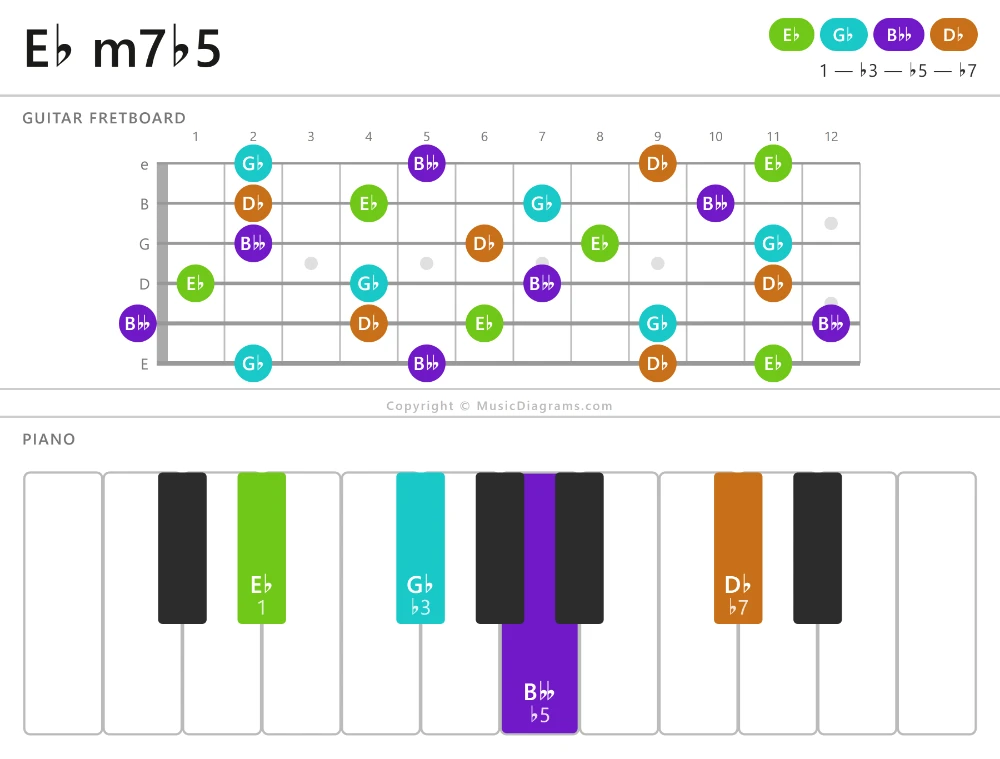
E-flat minor seven flat five is a Half-Diminished chord built from the notes E♭, G♭, B♭♭, and D♭. Its root is E♭, and its interval number formula is 1–♭3–♭5–♭7, which gives you the interval names root, minor third, diminished fifth, and minor seventh. You may also see this chord written as E♭m7♭5, E♭ø7, or E-flat half-diminished seventh. If you look at the widget above, you can see and hear how these four notes combine, and if you want to learn more about how these building blocks work, see chord intervals.
E♭ m7♭5 Alternate Names
- E♭m7♭5
- E♭ø7
- E-flat half-diminished seventh
E♭ m7♭5 Chord Notes
E♭ m7♭5 Chord Formula
E♭ m7♭5 Chord Notation
How To Use E♭ m7♭5 In Music
Because of its lowered third, lowered fifth, and lowered seventh, this chord has a dark, tense, and slightly unstable sound that often feels thoughtful or mysterious. It is commonly used to lead toward a stronger resolving chord, especially in minor keys. For example, in D♭ minor or its harmonic forms, E♭m7♭5 can function as iiø7 in a progression such as i–iiø7–V7–i, or appear in a jazz-style movement like vi–iiø7–V–i. The mood can feel softer or more dramatic depending on the chords around it: placed after a stable minor chord it adds suspense, while moving into a dominant chord increases pull and direction. If you are new to chord function, it also helps to understand the chord root when hearing why this chord wants to move.
E♭ m7♭5 Chord Inversions
Inversions happen when a note other than the root is the lowest note. For E♭m7♭5, root position is E♭–G♭–B♭♭–D♭, first inversion is G♭–B♭♭–D♭–E♭, second inversion is B♭♭–D♭–E♭–G♭, and third inversion is D♭–E♭–G♭–B♭♭. These inversions keep the same chord quality but can change the weight and color of the sound. A root-position shape often feels most grounded, while inversions can sound smoother, gentler, or more suspenseful depending on the bass note. Players and composers use inversions to create easier note movement between chords, make bass lines sing more naturally, and shape the emotional flow of a progression.