The E♭ mMaj7 Chord Explained
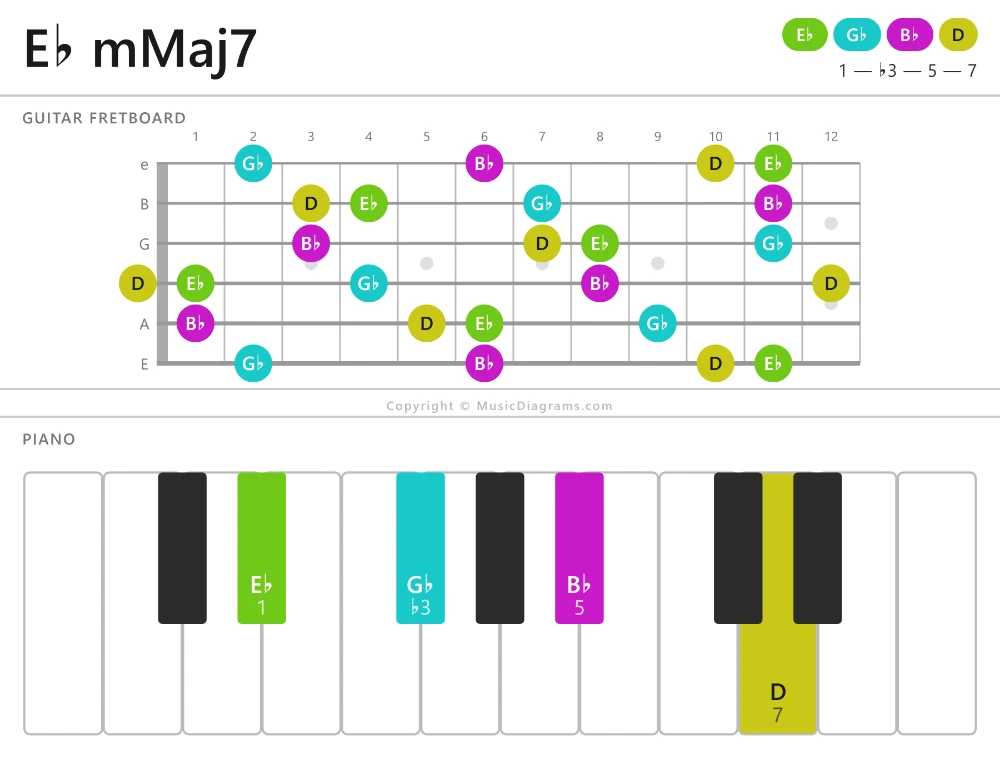
E-flat minor major seventh is a Minor chord family chord built from the notes E♭, G♭, B♭, and D. Its root is E♭, and its interval number formula is 1-♭3-5-7, which gives you the interval names root, minor third, perfect fifth, and major seventh. This unusual mix of a minor triad with a major seventh creates a rich, tense color that many beginners find striking. You may also see it written as E♭mMaj7, E♭min(maj7), or E-flat minor major seventh. If you look at the widget above, you can use the piano and guitar diagrams to spot these chord tones clearly and connect them to chord intervals.
E♭ mMaj7 Alternate Names
- E♭mMaj7
- E♭min(maj7)
- E-flat minor major seventh
E♭ mMaj7 Chord Notes
E♭ mMaj7 Chord Formula
E♭ mMaj7 Chord Notation
How To Use E♭ mMaj7 In Music
Because this chord combines a dark minor sound with a bright major seventh, it often feels mysterious, dramatic, elegant, or slightly uneasy. It can work well in jazz, film music, ballads, and more emotional harmonic settings where you want a chord that sounds stable and tense at the same time. Its mood depends a lot on the chords around it: moving from i to iv can make it feel thoughtful, while placing it before a stronger resolving chord can heighten suspense. For example, in E-flat minor you might hear i–iv–V–i, with E♭mMaj7 as the tonic color chord, or iiø–V–i in a jazz context where the final E♭mMaj7 gives the ending a more sophisticated sound than a plain minor chord. Since its root defines how we hear the chord, it can also help to review the chord root concept.
E♭ mMaj7 Chord Inversions
Another useful idea is inversion, which means keeping the same notes but placing a note other than the root at the bottom. For E♭ minor major seventh, root position is E♭-G♭-B♭-D, first inversion is G♭-B♭-D-E♭, second inversion is B♭-D-E♭-G♭, and third inversion is D-E♭-G♭-B♭. Inversions do not change the chord’s name family, but they do change its weight and color: first inversion can sound smoother, second inversion can feel more open, and third inversion often sounds especially tense because the major seventh is in the bass. Composers and songwriters use inversions to make bass lines move more smoothly, connect chords with less jumping, and shape the emotional flow of a progression.