The E m Chord Explained
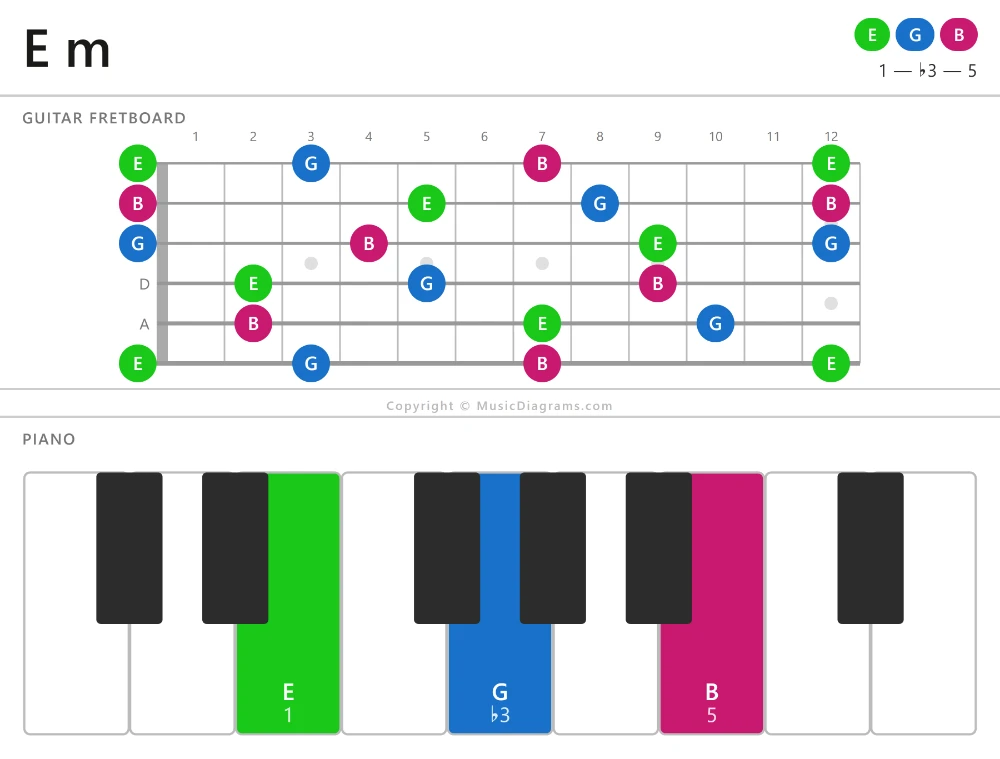
E minor is a Minor chord built from the notes E, G, and B. Its root is E, and its interval number formula is 1-♭3-5, which gives you the interval names root, minor third, and perfect fifth. This simple three-note shape is one of the most common chords in music, and the widget above can help you see and hear how these notes work together. If you are new to chords, it can also help to learn more about the chord root. You may also see this chord written as E minor chord, Em, or E min.
E m Alternate Names
- Em
- E minor chord
- E min
E m Chord Notes
E m Chord Formula
E m Chord Notation
How To Use E m In Music
Because it contains a minor third, E minor usually sounds darker, sadder, or more reflective than a major chord, but it can also feel calm, warm, or powerful depending on the music around it. For example, Em often appears as i in a minor key progression such as i-VI-III-VII, or as iii in a major key progression such as I-iii-IV-V. In the key of D major, Em can function as ii in a common ii-V-I style movement, while in E minor it may lead into chords like C or B to deepen the moody feeling. To better understand why the notes create this sound, you can explore chord intervals.
E m Chord Inversions
Another useful idea for beginners is inversion, which means the chord still has the same notes, but a different note is placed at the bottom. In root position, E minor is E-G-B. Its first inversion is G-B-E, and its second inversion is B-E-G. These inversions do not change the chord’s name, but they do change its color and feel: root position often sounds the most stable, first inversion can sound smoother or softer, and second inversion can feel more open or slightly less settled. Players use inversions to make chord changes easier, create smoother bass lines, and connect harmonies in a more musical way.