The E m11 Chord Explained
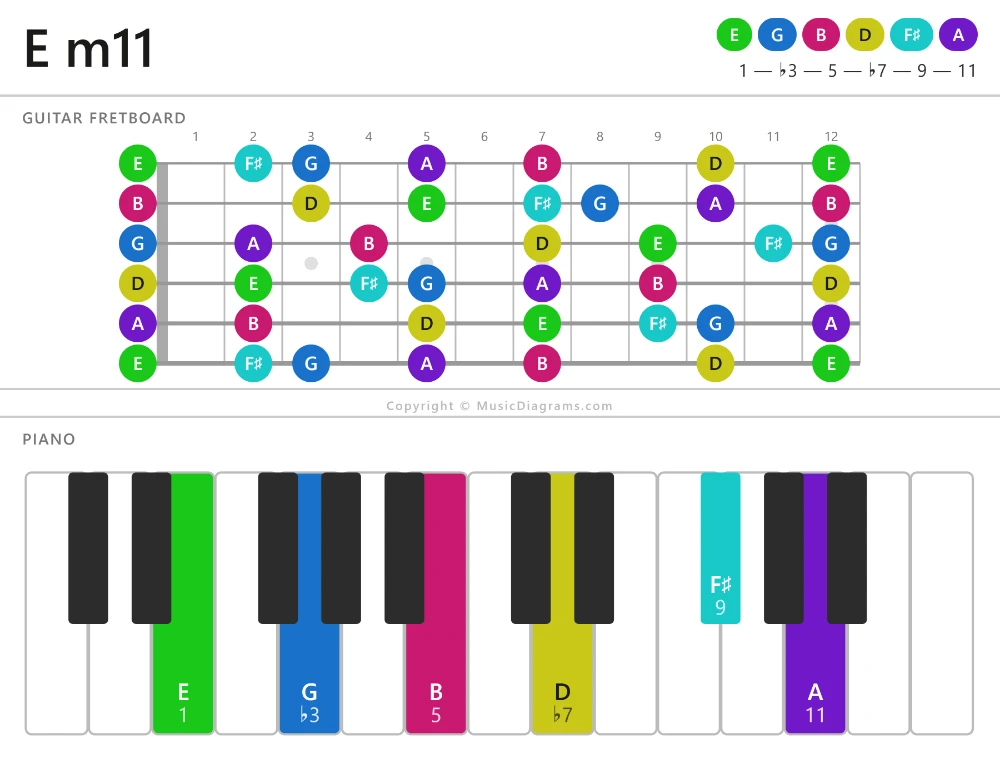
E minor eleventh is a Minor chord family color chord built from the notes E, G, B, D, F♯, and A. Its root is E, and its interval number formula is 1-♭3-5-♭7-9-11, which gives you the interval names root, minor third, perfect fifth, minor seventh, major ninth, and perfect eleventh. You may also see it written as Em11, Emin11, or E minor 11. If you look at the widget above, you can see and hear how these notes stack together, and learning a bit about chord intervals can make the structure much easier to understand.
E m11 Alternate Names
- Em11
- Emin11
- E minor 11
E m11 Chord Notes
E m11 Chord Formula
E m11 Chord Notation
How To Use E m11 In Music
Because E minor eleventh contains both the dark quality of a minor chord and the airy extension of the 9th and 11th, it often sounds spacious, reflective, jazzy, or gently emotional rather than harsh. It can work well in soul, jazz, pop, film music, and ambient styles when you want a richer sound than a basic minor chord. For example, it might appear as i in a progression like i–VI–III–VII in E minor, or as ii in D major during a jazz-style movement such as ii–V–I, where Em11 leads to A7 and then Dmaj7. The mood can shift depending on the surrounding harmony: next to brighter major chords it can feel wistful, while beside darker minor or tense dominant chords it can sound deeper and more dramatic. If you are new to harmony, it also helps to understand the chord root when hearing why this chord feels centered on E.
E m11 Chord Inversions
Another useful idea is inversion, which means the chord keeps the same notes but starts from a note other than the root. For E minor eleventh, root position has E in the bass, while inversions could place G, B, D, F♯, or A in the bass instead. An Em11/G inversion can sound softer and less final, while Em11/B may feel more open and balanced because the fifth is in the bass. Musicians use inversions to create smoother bass lines, connect chords more naturally, and change the weight or color of the harmony without changing the chord’s basic identity. You might also hear simpler variations such as leaving out B or even the 9th in some settings, since extended chords are often arranged in flexible ways to fit the instrument or musical texture.