The E m13 Chord Explained
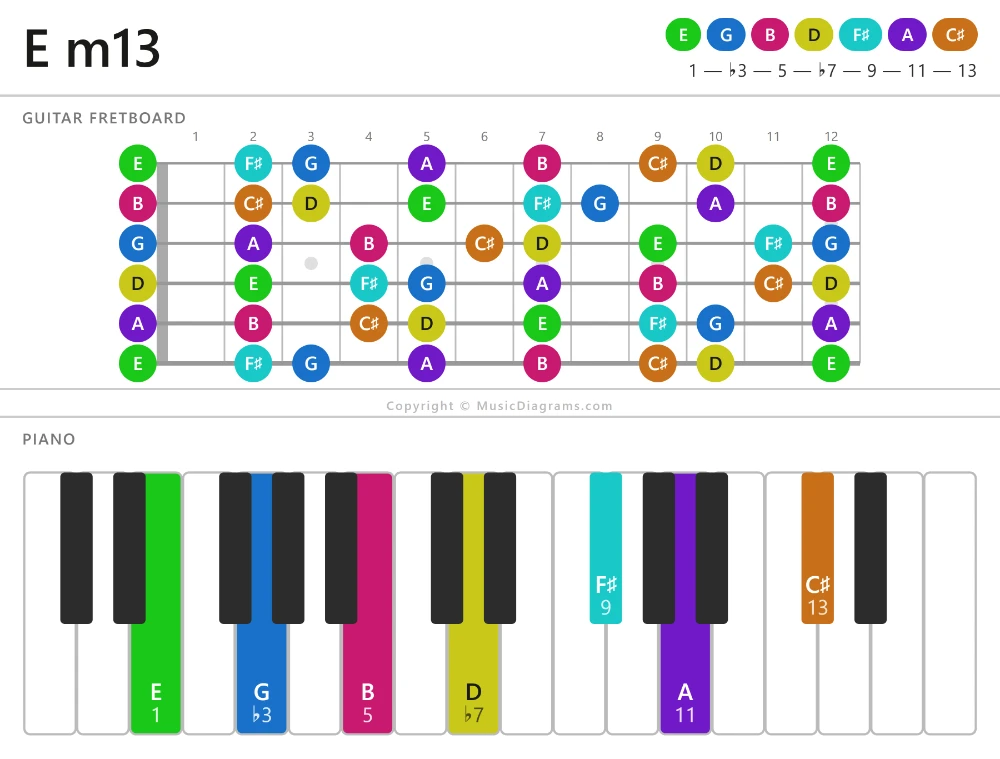
E minor thirteenth is a Minor chord family color chord built from the notes E, G, B, D, F♯, A, and C♯. Its root is E, and its interval number formula is 1-♭3-5-♭7-9-11-13. In interval names, that gives you root, minor third, perfect fifth, minor seventh, major ninth, perfect eleventh, and major thirteenth. You may also see it written as Em13, E min13, or E minor 13. If you look at the widget above, you can use the piano and guitar diagrams to visualize how all of these notes stack together, and the chord tones can help you hear how each note adds color. To better understand how this chord is built, see chord intervals.
E m13 Alternate Names
- Em13
- E min13
- E minor 13
E m13 Chord Notes
E m13 Chord Formula
E m13 Chord Notation
How To Use E m13 In Music
Because E minor 13 includes both the dark quality of a minor chord and the rich extension tones above it, it often sounds smooth, jazzy, soulful, and slightly mysterious. The basic minor sound comes from E to G, while the added D, F♯, A, and C♯ make the chord feel fuller and more expressive. Its mood can shift depending on the surrounding harmony: it may sound warm and floating in a mellow progression, or more tense and searching before resolving to a more stable chord. For example, in D major, Em13 can work as ii in a ii–V–I progression such as Em13–A7–Dmaj7. In E minor, it might appear as i in a progression like Em13–Am7–B7–Em. Since the chord contains a minor core, you may also find it helpful to compare its foundation with a minor chord.
E m13 Chord Inversions
Another useful idea is inversion, which means the chord keeps the same notes but starts on a note other than the root. For E minor 13, root position has E as the lowest note, but an inversion might place G, B, D, F♯, A, or C♯ in the bass instead. For example, an Em13/G puts G in the bass, while Em13/B puts B in the bass. These inversions do not change the chord’s name family, but they do change its feel: a root-position voicing can sound more settled, while inversions can sound softer, more flowing, or create smoother movement from one chord to the next. Musicians use inversions to make bass lines more melodic, reduce jumps between chords, and shape the emotional color of a progression with more subtlety.