The E m7 Chord Explained
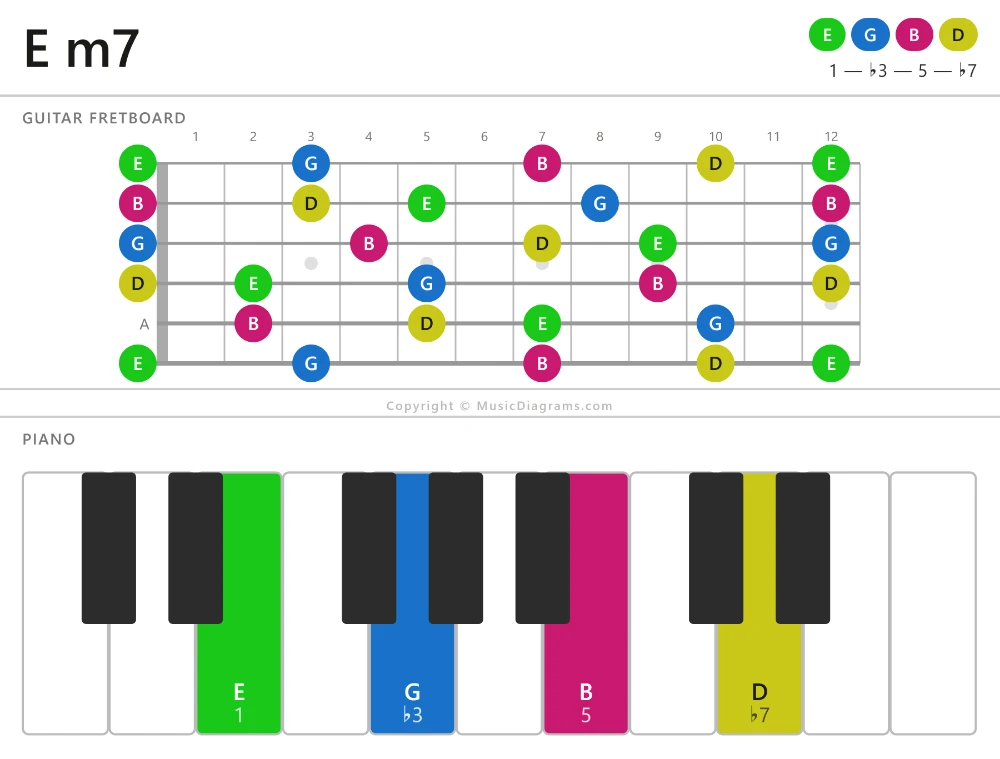
E minor seventh is a Minor chord family chord built from the notes E, G, B, and D. Its root is E, and its interval number formula is 1-♭3-5-♭7, which gives you the interval names root, minor third, perfect fifth, and minor seventh. You may also see it written as Em7, E min7, or E-7. If you look at the widget above, you can see and hear how these four notes combine, and learning a bit about chord intervals can make this structure much easier to understand.
E m7 Alternate Names
- Em7
- E min7
- E-7
E m7 Chord Notes
E m7 Chord Formula
E m7 Chord Notation
How To Use E m7 In Music
Often, E minor seventh sounds smooth, warm, thoughtful, and a little jazzy compared with a plain E minor triad. It can create a relaxed or reflective mood on its own, but the surrounding chords strongly affect how you hear it. For example, in the key of D major, Em7 can work as ii in a classic ii-V-I progression: Em7-A7-Dmaj7. In the key of D major or B minor, it may also appear in a softer progression such as G-Em7-A-D, where it adds color between brighter chords. In E minor, it can function as i in a progression like i-VI-III-VII: Em7-C-G-D. Because it includes the minor seventh, it feels richer than a basic minor chord, and it can sound more settled, more open, or more tense depending on what comes before and after it.
E m7 Chord Inversions
Another useful idea is inversion, which means playing the same chord with a note other than the root at the bottom. For E minor seventh, root position is E-G-B-D, while the 1st inversion is G-B-D-E, the 2nd inversion is B-D-E-G, and the 3rd inversion is D-E-G-B. These inversions keep the same notes but can change the weight and flow of the sound. A root-position Em7 often feels most stable, while inversions can sound softer, less final, or more connected to the next chord. Players use inversions to create smoother bass movement, make chord progressions easier to play, and shape the mood with a gentler or more floating character.