The E mMaj9 Chord Explained
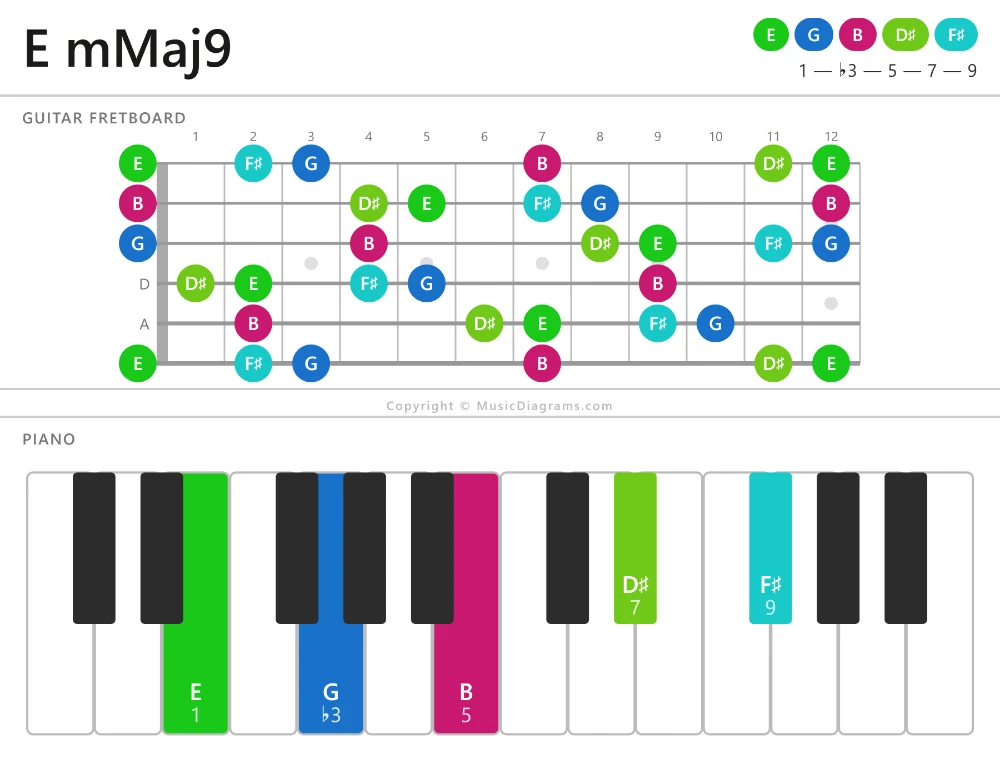
E minor major ninth is a Minor chord family sound built from the notes E, G, B, D♯, and F♯. Its root is E, and its interval number formula is 1-♭3-5-7-9. Those intervals are named root, minor third, perfect fifth, major seventh, and major ninth. You may also see this chord written as E mMaj9, Em(maj9), or E minor major 9. If you look at the widget above, you can use it to visualize where these chord tones sit on piano and guitar, and to hear how the notes combine. If you are new to this idea, learning about chord intervals can make the structure much easier to understand.
E mMaj9 Alternate Names
- Em(maj9)
- E minor major 9
- EmMaj9
E mMaj9 Chord Notes
E mMaj9 Chord Formula
E mMaj9 Chord Notation
How To Use E mMaj9 In Music
Because it combines a minor triad with a bright major seventh and ninth, E mMaj9 has a rich, tense, and slightly mysterious sound. It can feel emotional, cinematic, jazzy, or haunting depending on what comes before and after it. On its own, the chord often suggests introspection, but surrounding harmony changes its effect: after a stable tonic it can sound surprising, and before a resolution it can feel full of suspense. For example, in E minor you might hear i–VI–III–VII with E mMaj9 used as the i, or in a jazzier setting something like iv–V–i where E mMaj9 becomes the final color chord. Its color can also stand out next to simpler sonorities such as a minor chord, making the major seventh and ninth feel especially expressive.
E mMaj9 Chord Inversions
Another useful idea is inversion, which means a note other than the root is placed in the bass. For E mMaj9, root position has E as the lowest note, while inversions could place G, B, D♯, or F♯ in the bass. For example, an E mMaj9/G inversion can sound softer and more unsettled, while E mMaj9/B may feel a little more open and balanced. Players also use partial variations such as EmMaj7 or Em(add9) when they want a related color with fewer notes. Inversions are helpful because they create smoother bass lines, connect chords more naturally, and subtly change the mood without changing the chord’s basic identity.