The E♯ 6/9 Chord Explained
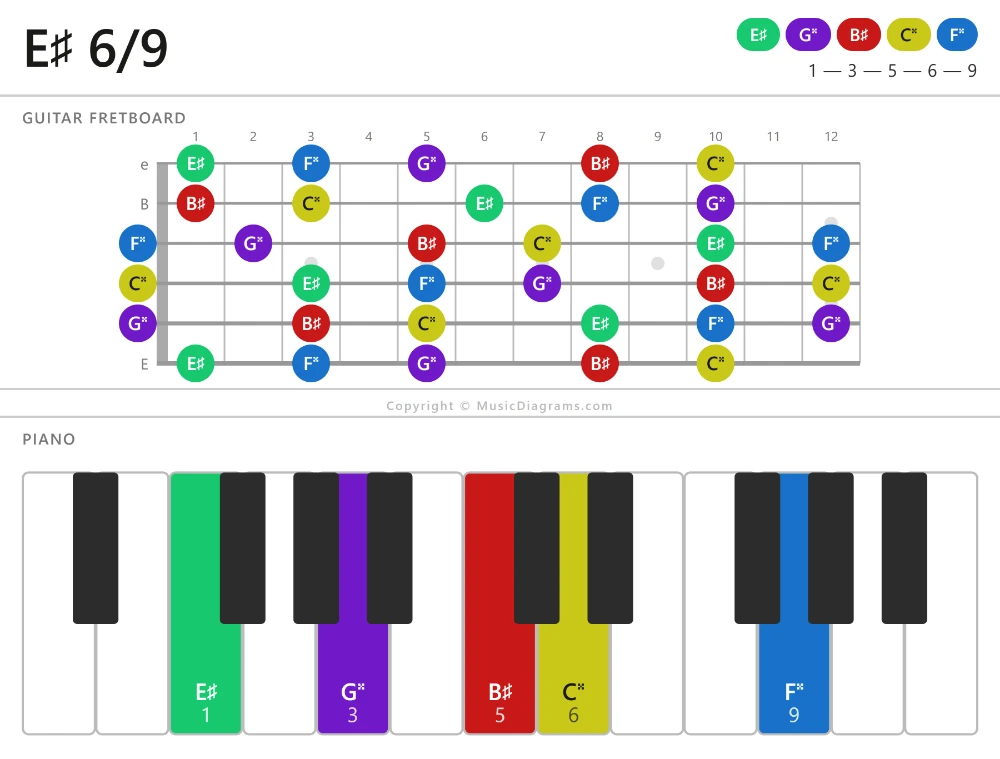
E-sharp 6/9 is a chord in the Major family. It uses the notes E♯, G♯♯, B♯, C♯♯, and F♯♯. The root is E♯, which is the note the chord is built from, and you can learn more about that in this guide to chord roots. Its interval number formula is 1–3–5–6–9, which gives you the interval names root, major third, perfect fifth, major sixth, and major ninth. In plain-text spelling, this chord may also be called E-sharp major 6/9, and it can appear in symbols such as E♯6/9 or E♯maj6/9. If you look at the widget above, you can see and hear how these five chord tones combine into a bright, full major sound.
E♯ 6/9 Alternate Names
- E♯6/9
- E-sharp major 6/9
- E♯maj6/9
E♯ 6/9 Chord Notes
E♯ 6/9 Chord Formula
E♯ 6/9 Chord Notation
How To Use E♯ 6/9 In Music
Because it is a major chord with added color tones, E♯ 6/9 sounds warm, smooth, open, and slightly jazzy without feeling tense. The major triad gives it stability, while the 6th and 9th add brightness and softness, making it useful in pop, jazz, soul, film music, and gentle accompaniment patterns. Its mood can feel more restful when it resolves from or to stronger chords, and the surrounding harmony changes how you hear it. For example, it could act as I in a progression like I–vi–IV–V, or as a colorful tonic area in I–ii–V–I. It may also appear after a stronger dominant chord to create a relaxed landing point. In note-based examples, E♯6/9 might move to A♯ minor or follow B♯7 depending on the key and style.
E♯ 6/9 Chord Inversions
Another useful idea is inversion, which means playing the same chord with a note other than the root at the bottom. For E♯ 6/9, a player might place G♯♯, B♯, C♯♯, or even F♯♯ in the bass while still keeping the chord quality of E-sharp 6/9. These inversions do not change the chord’s name in a basic sense, but they do change the weight, texture, and flow. A root-position shape often sounds settled and clear, while an inversion can sound lighter, smoother, or more connected to the next chord. Musicians use inversions to make bass lines sing, reduce large jumps between chords, and create a gentler mood. Related variations may include leaving out one color tone in a practical voicing, but the full 1–3–5–6–9 structure is what defines the complete chord.