The E♯ dim Chord Explained
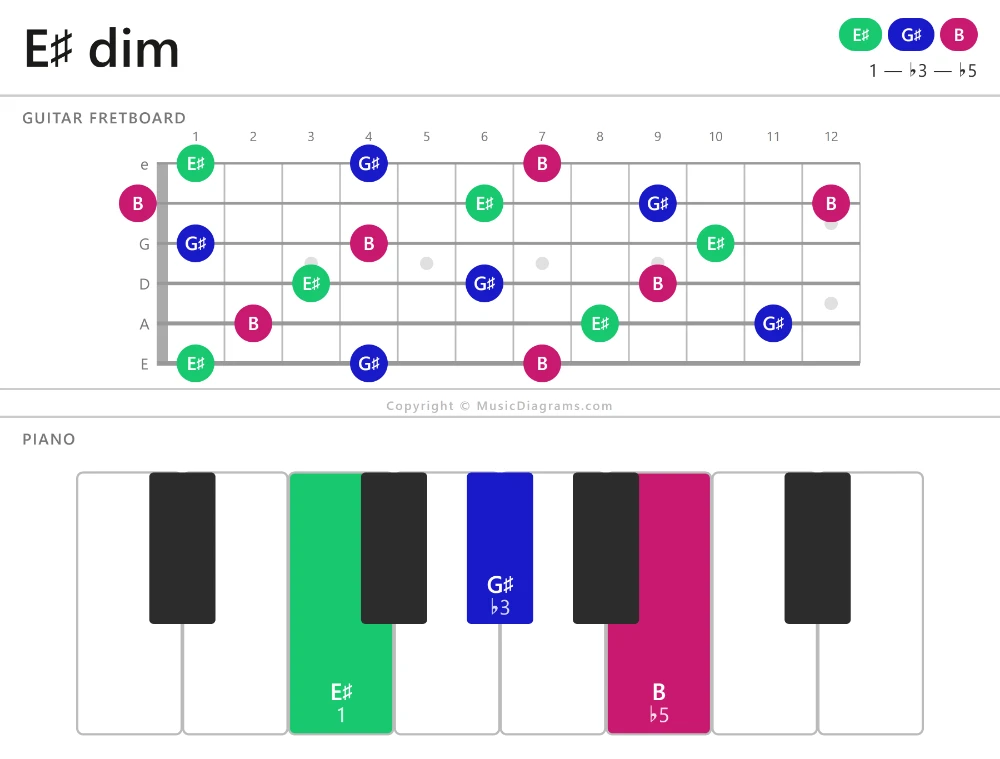
E-sharp diminished is a Diminished chord built from the notes E-sharp, G-sharp, and B. Its root is E-sharp, so that note gives the chord its name and acts as the starting point for hearing its sound; if you want to learn more about that idea, see chord root explained. The interval number formula is 1-♭3-♭5, which means the chord contains a root, a minor third, and a diminished fifth. You may also see this chord written as E♯dim, E♯° or E-sharp diminished triad. Using the widget above, you can match these three notes on piano or guitar and hear how the chord is constructed.
E♯ dim Alternate Names
- E♯dim
- E♯°
- E-sharp diminished triad
E♯ dim Chord Notes
E♯ dim Chord Formula
E♯ dim Chord Notation
How To Use E♯ dim In Music
Because it contains a lowered third and lowered fifth, this chord sounds tense, unstable, and dramatic, often creating suspense that wants to resolve to a more settled chord. Beginners often hear diminished chords as mysterious or uneasy, and E-sharp diminished can be especially useful as a passing chord between more stable harmonies. For example, in a minor-key progression it might function like a leading-tone diminished chord in a pattern such as i-vii°-i, or appear in a motion like iv-vii°-i to increase pull back to the tonic. Its mood can feel sharper or softer depending on the surrounding harmony: next to a minor chord it may sound darker, while next to a brighter chord it can sound more restless. To better understand why its notes create that pull, you can explore chord intervals.
E♯ dim Chord Inversions
Another useful idea for beginners is inversion, which means keeping the same notes of the chord but putting a note other than the root on the bottom. In root position, E-sharp diminished is E-sharp-G-sharp-B. In first inversion, G-sharp is the lowest note, giving G-sharp-B-E-sharp. In second inversion, B is the lowest note, giving B-E-sharp-G-sharp. These inversions do not change the chord’s basic identity, but they do change its color and smoothness. A first inversion can sound a little less direct, while a second inversion can feel even more suspended or transitional. Musicians use inversions to make bass lines move more smoothly, connect chords with less jumping, and shape the mood of a progression in a more flowing way.