The E♯ m13 Chord Explained
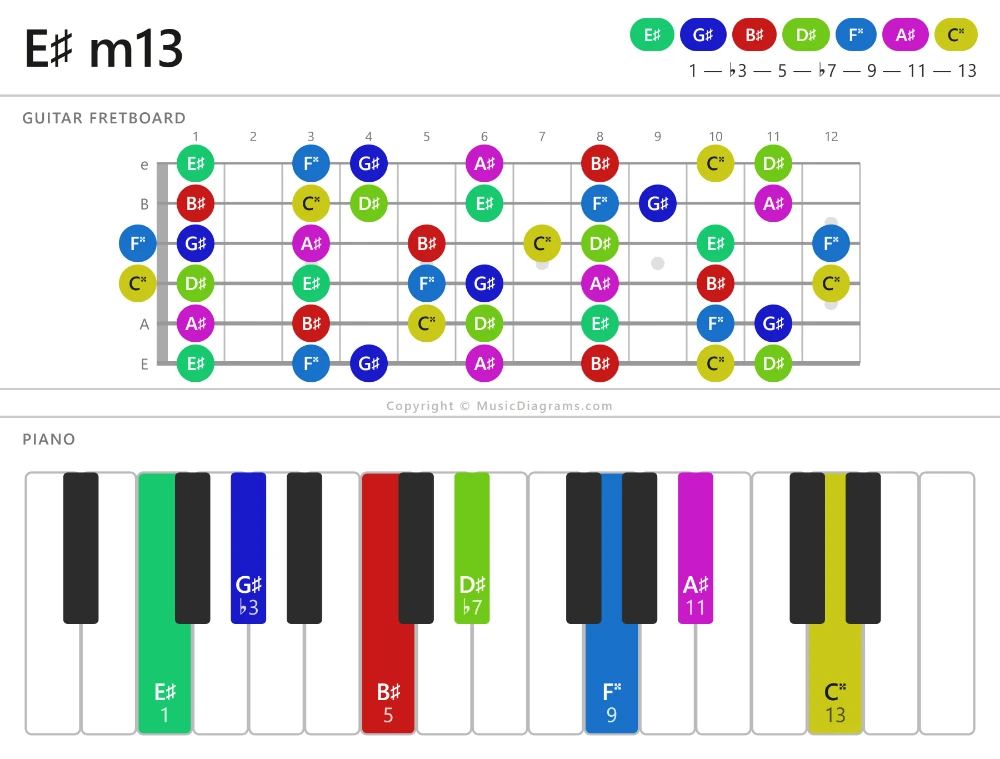
E-sharp minor thirteenth is a Minor chord in the extended-chord family, built from the notes E♯, G♯, B♯, D♯, F♯♯, A♯, and C♯♯. Its root is E♯, and its interval number formula is 1–♭3–5–♭7–9–11–13. In interval names, that gives you the root, minor third, perfect fifth, minor seventh, major ninth, perfect eleventh, and major thirteenth. You may also see it written as E♯m13, E♯min13, or E♯-13. If you are new to chords, the widget above can help you see and hear the root-position notes clearly, and learning a bit about chord intervals makes this large chord much easier to understand.
E♯ m13 Alternate Names
- E♯m13
- E♯min13
- E♯-13
E♯ m13 Chord Notes
E♯ m13 Chord Formula
E♯ m13 Chord Notation
How To Use E♯ m13 In Music
Because it combines a minor triad with rich color tones, E♯m13 sounds deep, jazzy, smooth, and slightly tense at the same time. It can create a reflective, sophisticated, or late-night mood, but the chords around it strongly affect how it feels: placed before a bright resolution it can sound like a gentle setup, while surrounded by darker harmony it can feel more mysterious. For example, in a minor jazz progression it might appear as i–iv–V–i, with E♯m13 acting as the i chord, or in a longer cycle such as ii–V–i where extended minor sonorities add color rather than simple stability. Compared with a basic minor chord, this chord has much more harmonic detail, so composers and arrangers often use it in jazz, soul, R&B, and film music.
E♯ m13 Chord Inversions
Another useful idea is inversion, which means playing the same chord with a note other than the root in the bass. For E♯m13, one inversion might place G♯ in the bass, while another could place B♯ or D♯ in the bass. Even though the chord quality stays minor thirteenth, the sound changes: inversions can make the chord feel smoother, less rooted, or more connected to the next chord. Players use them to improve voice-leading, create a gentler bass line, and shape the mood without changing the basic harmony. Variations may also omit some upper notes in practical playing, but the full chord color still comes from the combination of the minor quality with the 7th, 9th, 11th, and 13th.