The E♯ m7♭9 Chord Explained
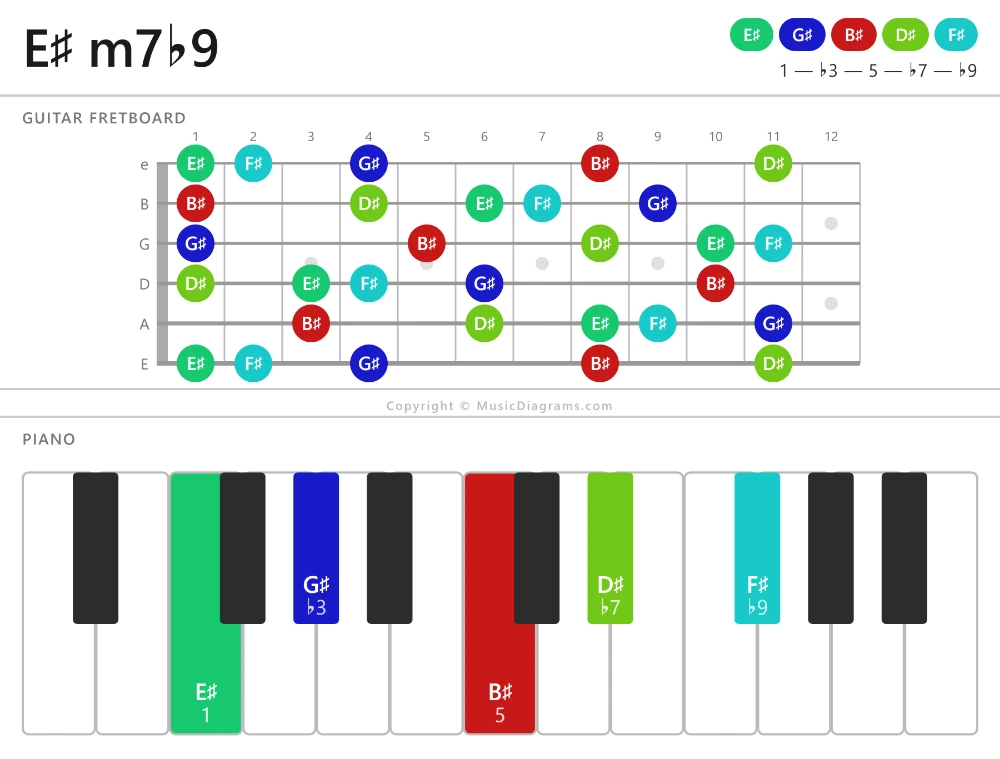
E-sharp minor seventh flat ninth is a Minor chord family sound with an added flat ninth color. Its notes are E♯, G♯, B♯, D♯, and F♯. The root is E♯, which gives the chord its name, and you can learn more about that in this guide to chord roots. The interval number formula is 1-♭3-5-♭7-♭9, and the interval names are root, minor third, perfect fifth, minor seventh, and minor ninth. You may also see it written as E♯m7♭9, E♯min7♭9, or E♯-7♭9 in plain-text spelling as E-sharp minor seventh flat ninth.
E♯ m7♭9 Alternate Names
- E♯m7♭9
- E♯min7♭9
- E♯-7♭9
E♯ m7♭9 Chord Notes
E♯ m7♭9 Chord Formula
E♯ m7♭9 Chord Notation
How To Use E♯ m7♭9 In Music
Because this chord combines a minor seventh sound with the extra tension of a flat ninth, it often feels dark, tense, expressive, and slightly unresolved. The flat ninth creates a strong pull, so this chord can work well in dramatic passages, jazz-influenced harmony, film music, or as a color chord leading toward a more stable destination. Its mood can shift depending on the chords around it: placed before a calmer chord, it sounds more urgent, while surrounded by other tense chords, it can feel mysterious and rich. For example, in a progression like i-iv-i, E♯m7♭9 could serve as the tonic color chord, or in a more extended minor movement such as i-VI-iiø-V, it can deepen the emotional pull at the start. If you want to understand how these chord tones create that sound, this overview of chord intervals is helpful. You can also use the widget above to see and hear the chord tones clearly.
E♯ m7♭9 Chord Inversions
Another useful idea is inversion, which means keeping the same chord notes but placing a note other than the root in the bass. For E♯m7♭9, root position has E♯ at the bottom, while inversions could place G♯, B♯, D♯, or F♯ in the bass. These choices do not change the chord name at its core, but they do change the weight and color of the sound. A bass note of G♯ can make the chord feel smoother and more connected, while D♯ or F♯ in the bass can make it sound more unstable or floating. Composers and songwriters use inversions to create stepwise bass lines, smoother transitions between chords, and different emotional shades without changing the basic harmony. Related variations may include leaving out a note for a lighter texture or spreading the notes farther apart for a more open sound.