The E♯ m9 Chord Explained
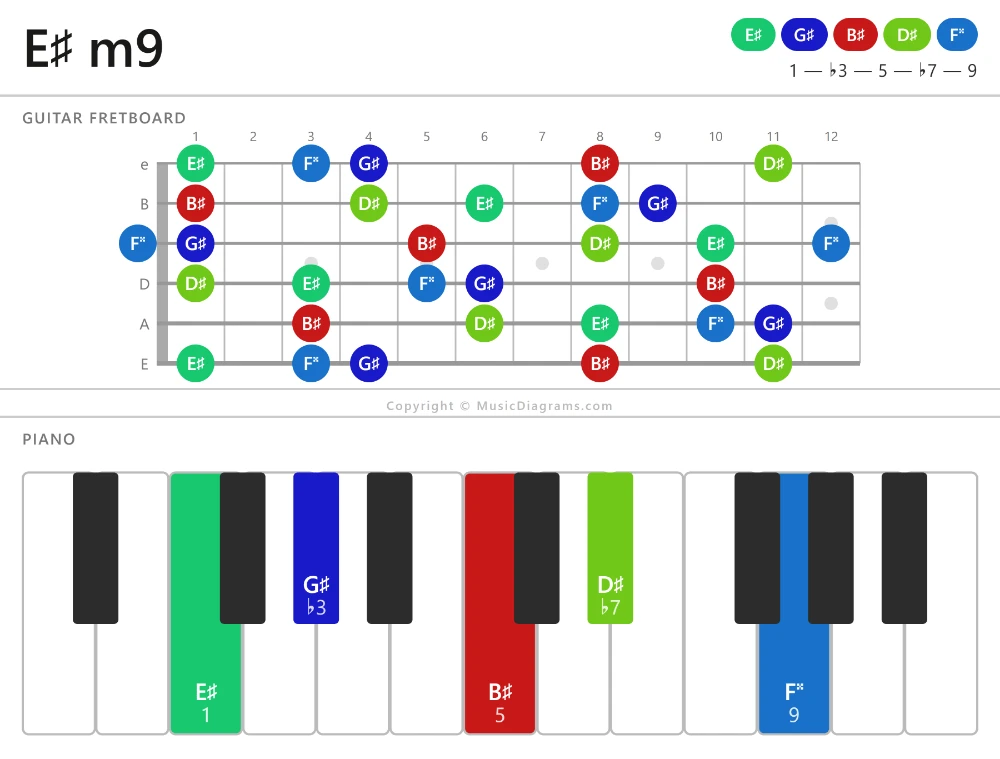
E-sharp minor ninth is a Minor chord family sonority built from the notes E♯, G♯, B♯, D♯, and F♯♯. Its root is E♯, and its interval number formula is 1–♭3–5–♭7–9. In interval names, that gives you the root, minor third, perfect fifth, minor seventh, and major ninth. You may also see it written as E♯m9, E♯min9, or E♯-9 in plain-text spelling. If you look at the widget above, you can match these notes on piano or guitar and hear how the added ninth expands the basic minor sound; this also helps when learning more about chord intervals.
E♯ m9 Alternate Names
- E♯m9
- E♯min9
- E♯-9
E♯ m9 Chord Notes
E♯ m9 Chord Formula
E♯ m9 Chord Notation
How To Use E♯ m9 In Music
Because it combines a dark minor core with the color of the ninth, this chord often sounds smooth, reflective, jazzy, and slightly tense in a gentle way rather than harsh. It can work well in soul, jazz, film music, and expressive pop when a plain minor chord feels too simple. The mood of E♯m9 can change depending on the chords around it: placed after a brighter chord it may feel more wistful, while moving toward a stronger resolution it can sound more expectant. For example, it might appear as i in a minor progression like i–VI–III–VII, with E♯m9 as the home chord, or as iii in a major-key color progression such as I–iii–vi–IV. In some styles, extended minor chords like this are chosen instead of a simpler triad to create a richer version of what you hear in a minor chord.
E♯ m9 Chord Inversions
Another helpful idea is inversion, which means playing the same chord tones but putting a note other than the root in the bass. For E♯m9, a possible inversion could place G♯ in the bass, B♯ in the bass, D♯ in the bass, or even F♯♯ in the bass, while still using the notes of the chord. Inversions do not change the chord’s name category, but they do change the weight and color of the sound: a root-position version feels most settled, while other bass notes can sound softer, more flowing, or more unstable. Musicians use inversions to make bass lines smoother, connect chords with less jumping, and shape the emotional pull of a progression. Closely related variations include simpler forms such as E♯m, E♯m7, or fuller voicings that rearrange the same notes in different octaves.