The E♯ mMaj7 Chord Explained
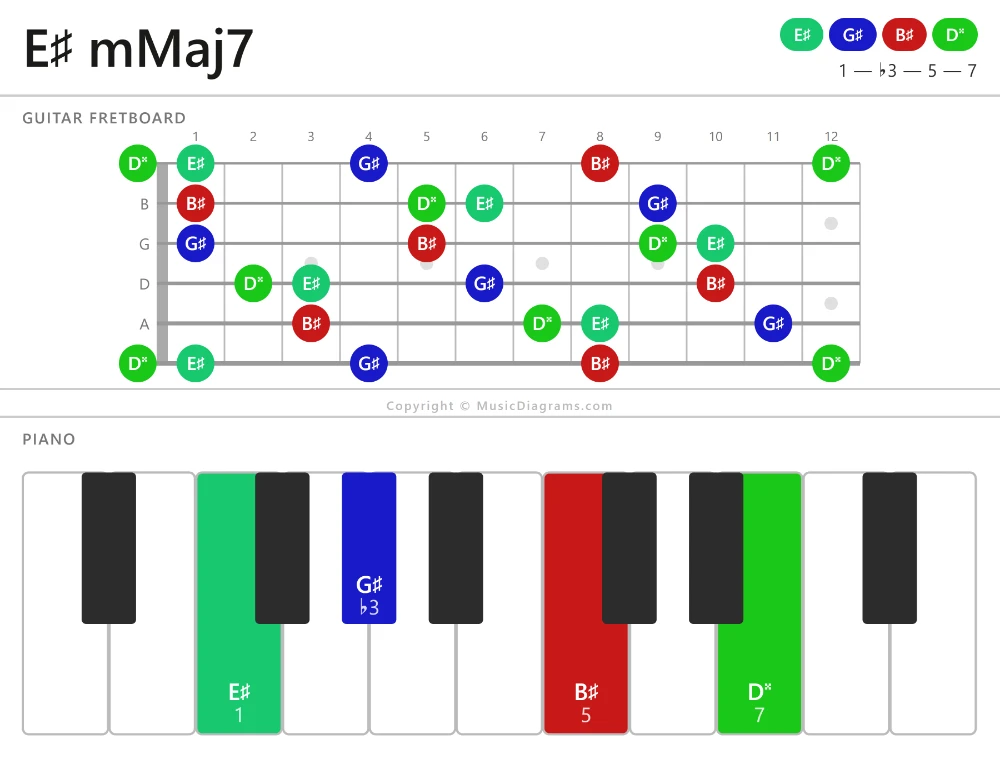
E-sharp minor major seventh is a Minor chord family chord built from the notes E♯, G♯, B♯, and D♯♯. Its root is E♯, and its interval number formula is 1-♭3-5-7. That means the chord contains a root, minor third, perfect fifth, and major seventh. You may also see it written as E♯mMaj7, E♯min(maj7), or E♯-maj7. If you look at the widget above, you can use the piano and guitar diagrams to spot these notes clearly, and the note tones can help you hear how the chord is stacked. To learn more about how these distances work, see chord intervals.
E♯ mMaj7 Alternate Names
- E♯mMaj7
- E♯min(maj7)
- E♯-maj7
E♯ mMaj7 Chord Notes
E♯ mMaj7 Chord Formula
E♯ mMaj7 Chord Notation
How To Use E♯ mMaj7 In Music
Because of the clash between its sad minor color and its bright major seventh, this chord sounds mysterious, emotional, and a little tense. Beginners often hear it as dramatic or cinematic. It can work well as a i chord in a minor key with a sophisticated twist, or as a color chord that leads smoothly into other harmonies. For example, in a minor-style progression it might appear as i-iv-V-i, where E♯mMaj7 gives the tonic a more complex feeling than a plain minor chord. It can also show up in jazzier movement such as ii-V-i, or in chromatic lines where nearby chords change how dark, dreamy, or unstable it feels. If the chords around it are simple, this chord stands out more; if the surrounding harmony is richer, it can blend in as part of a smooth emotional flow.
E♯ mMaj7 Chord Inversions
Inversions happen when a note other than the root is the lowest note. For E♯ minor major seventh, root position is E♯-G♯-B♯-D♯♯, first inversion is G♯-B♯-D♯♯-E♯, second inversion is B♯-D♯♯-E♯-G♯, and third inversion is D♯♯-E♯-G♯-B♯. These inversions keep the same four notes but change the bass note, which changes the weight and feel of the chord. A root-position shape sounds the most settled, while inversions can sound lighter, more flowing, or more tense depending on which note is in the bass. Writers use inversions to make bass lines smoother, connect chords with less jumping, and create different shades of emotion without changing the chord itself. If you want more background on chord construction, see minor chord basics.