The F♭ m Chord Explained
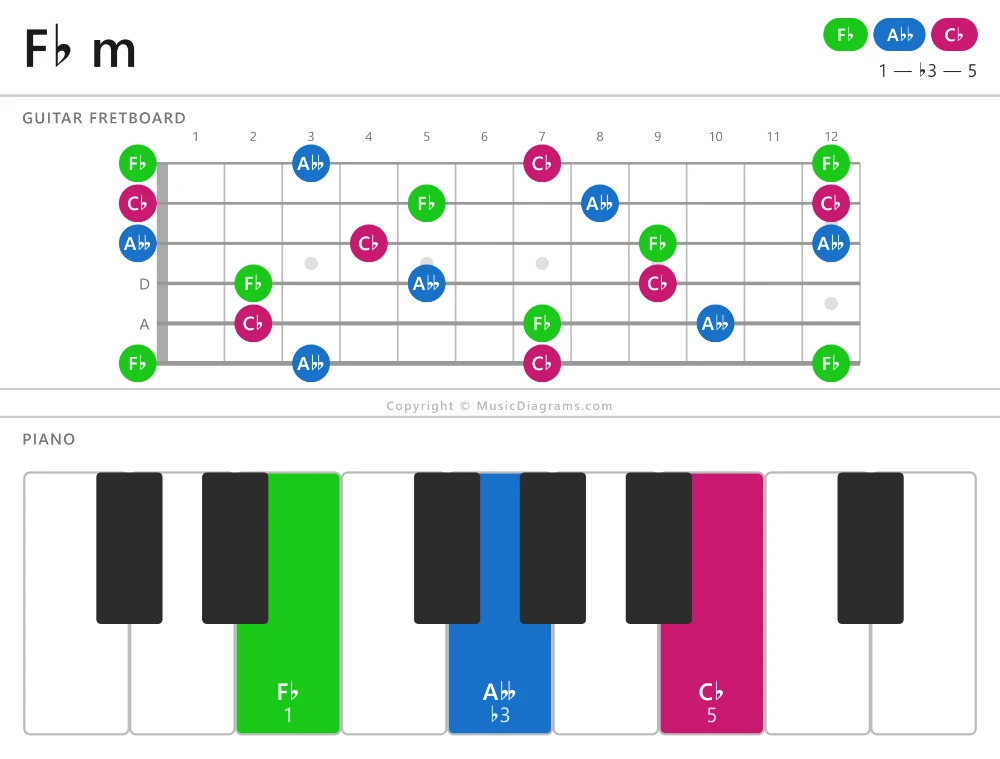
F-flat minor is a Minor chord family chord built from the notes F-flat, A-double-flat, and C-flat. Its root is F-flat, and its interval number formula is 1-♭3-5, which gives you the interval names root, minor third, and perfect fifth. You may also see it written as F♭m or F-flat minor triad. If you look at the widget above, you can use it to see where these three chord tones fall on piano and guitar, and hearing them can make the structure easier to understand. If you are new to chord construction, this overview of chord intervals can help connect the note names to the formula.
F♭ m Alternate Names
- F♭m
- F-flat minor
- F♭ minor triad
F♭ m Chord Notes
F♭ m Chord Formula
F♭ m Chord Notation
How To Use F♭ m In Music
Often, F-flat minor sounds dark, gentle, and a little introspective, which is typical of a minor triad. On its own, it can feel calm or sad, but the chords around it can make it sound warmer, more dramatic, or more tense. For example, in a minor-style progression such as i–VI–III–VII, F-flat minor could act as the i chord, giving the progression a clear home base. In another context, it might appear as the vi chord in a major-key pattern like I–V–vi–IV, where it adds emotional color between brighter chords. Because minor chords are so expressive, they are common in ballads, film music, pop, and rock, and you can compare their overall character with the ideas in this guide to minor chords.
F♭ m Chord Inversions
Another useful idea for beginners is inversion, which means the chord keeps the same notes but starts from a different note as the lowest pitch. In root position, F-flat minor is F-flat–A-double-flat–C-flat. In 1st inversion, A-double-flat is the lowest note, giving A-double-flat–C-flat–F-flat, and in 2nd inversion, C-flat is the lowest note, giving C-flat–F-flat–A-double-flat. These inversions still sound like F-flat minor, but they can feel smoother, lighter, or less settled depending on the bass note. Musicians use inversions to connect chords more smoothly, shape the bass line, and create a different sense of movement without changing the chord’s basic identity.