The F♭ m7 Chord Explained
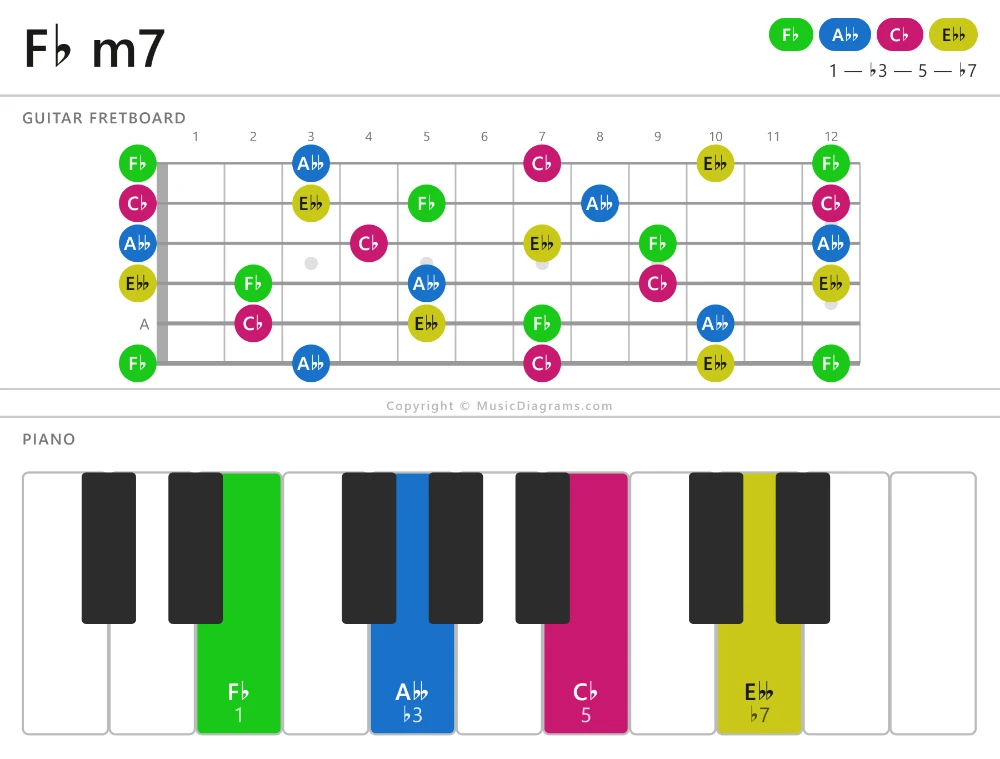
F-flat minor seventh is a Minor chord family chord built from the notes F-flat, A-double-flat, C-flat, and E-double-flat. Its root is F-flat, and its interval formula is 1-♭3-5-♭7, which gives you the interval names root, minor third, perfect fifth, and minor seventh. You may also see it written as F-flat minor 7, F-flat min7, or F-flat -7. If you look at the widget above, you can use the piano and guitar diagrams to visualize these chord tones and hear how they blend together. To understand why these notes create this sound, it helps to learn more about chord intervals.
F♭ m7 Alternate Names
- F-flat minor 7
- F-flat min7
- F-flat -7
F♭ m7 Chord Notes
F♭ m7 Chord Formula
F♭ m7 Chord Notation
How To Use F♭ m7 In Music
Because it includes both a minor triad and a minor seventh, F-flat minor seventh has a soft, moody, and slightly jazzy sound. Beginners often hear it as warmer and smoother than a basic minor chord, with a more colorful and relaxed character. It can work in jazz, soul, R&B, pop, and film music, and its mood can shift depending on the chords around it. For example, it might appear as ii in a progression like G-flat major: ii–V–I, where F-flat minor seventh leads toward B-flat dominant seventh and then resolves to E-flat major spelled enharmonically in context. It could also function in a minor-key style progression such as i–iv–v–i, where a minor seventh chord adds extra richness compared with a plain minor triad. If you want a simpler point of comparison, you can also read about what a minor chord is.
F♭ m7 Chord Inversions
Another useful idea is inversion, which means the chord keeps the same notes but a different note is placed at the bottom. In root position, F-flat minor seventh has F-flat as the lowest note. Its inversions are first inversion with A-double-flat in the bass, second inversion with C-flat in the bass, and third inversion with E-double-flat in the bass. These inversions do not change the chord’s name family, but they do change its texture, balance, and sense of motion. A root-position shape often sounds most stable, while inversions can sound smoother when moving from chord to chord because the bass line travels by smaller steps. Songwriters and arrangers use inversions to create gentler transitions, different bass movement, and a fresh color without changing the basic harmony.