The F♭ maj9 Chord Explained
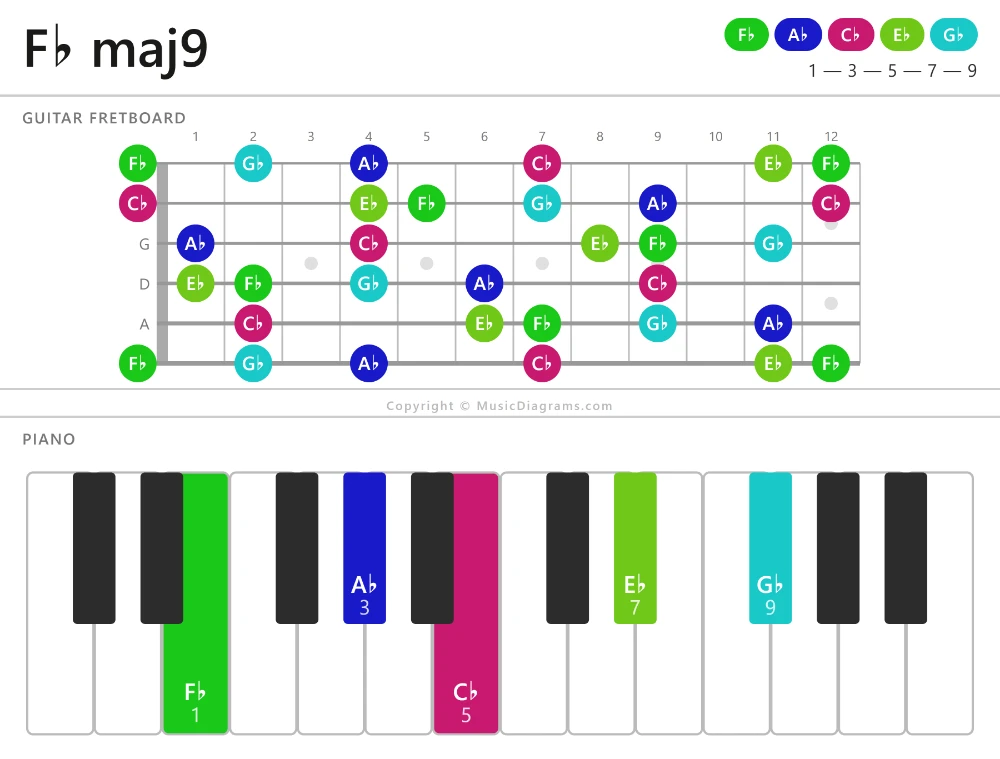
F-flat major ninth is a Major chord family sound built from the notes F-flat, A-flat, C-flat, E-flat, and G-flat. Its root is F-flat, which is the note the chord is named after, and you can learn more about that idea here: chord root. The interval number formula is 1–3–5–7–9, and the interval names are root, major third, perfect fifth, major seventh, and major ninth. In plain-text spelling, this chord may also be called F-flat major 9, and common symbols include F♭maj9 and F♭Δ9. If you look at the widget above, you can see and hear how these five notes combine to create the full chord color.
F♭ maj9 Alternate Names
- F-flat major 9
- F♭maj9
- F♭Δ9
F♭ maj9 Chord Notes
F♭ maj9 Chord Formula
F♭ maj9 Chord Notation
How To Use F♭ maj9 In Music
Because it contains both a major seventh and a ninth, this chord sounds smooth, rich, warm, and slightly dreamy rather than simple or plain. Beginners often hear major ninth chords as more colorful versions of major seventh chords, giving songs a polished jazz, soul, pop, or film-music feel. The mood can feel peaceful on its own, but the chords around it can change that impression: after a tense chord it may sound like a soft release, while before a stronger arrival it can feel gently suspended. For example, in a major-key style progression, Imaj9 can appear in patterns like Imaj9–vi–ii–V or iii–vi–ii–V–Imaj9. In the key where F-flat is the tonic, the chord F-flat major ninth functions as Imaj9. To understand why the notes stack this way, see chord intervals.
F♭ maj9 Chord Inversions
Another helpful idea is inversion, which means playing the same chord tones in a different order so a note other than the root is the lowest note. For F-flat major ninth, root position has F-flat at the bottom, while inversions could place A-flat, C-flat, E-flat, or G-flat in the bass. These changes do not create a completely new chord quality, but they do change the weight and flow of the sound. A chord with A-flat in the bass can feel a bit lighter and smoother, while one with E-flat or G-flat in the bass may sound more floating or open. Musicians use inversions to make progressions connect more smoothly, avoid large jumps between chords, and shape the mood with a gentler or more grounded bass movement.