The F♯ 9 Chord Explained
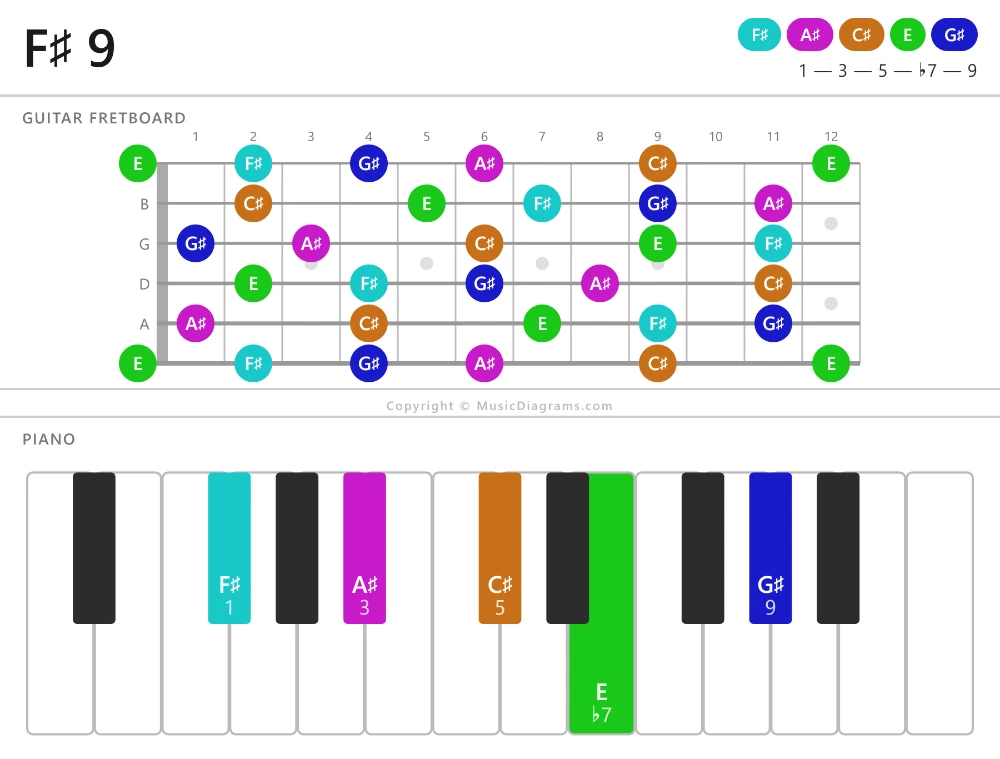
F-sharp ninth is a Dominant chord built from the notes F♯, A♯, C♯, E, and G♯. Its root is F♯, and its interval number formula is 1–3–5–♭7–9, which gives you the interval names root, major third, perfect fifth, minor seventh, and major ninth. You may also see it written as F♯9, F#9, or F-sharp dominant ninth. If you look at the widget above, you can use it to see these chord tones laid out clearly on piano and guitar, and learning how each note stacks from the root can become easier when you study chord intervals.
F♯ 9 Alternate Names
- F♯9
- F#9
- F-sharp dominant ninth
F♯ 9 Chord Notes
F♯ 9 Chord Formula
F♯ 9 Chord Notation
How To Use F♯ 9 In Music
Because this chord contains both a strong dominant seventh sound and the added ninth, F-sharp ninth often sounds tense, bluesy, rich, and energetic. It can create motion that wants to resolve, but it also has enough color to stand on its own in funk, jazz, blues, rock, and soul. In a key where it acts as the dominant, it may lead naturally toward the tonic, such as V9–I, or appear in a turnaround like ii–V9–I. For example, in B major, F♯9 can work as V9 in C♯m7–F♯9–Bmaj7, while in blues it might appear as the main dominant color in I–IV–V movement. The chords around it affect its mood a lot: next to softer major chords it can feel bright and exciting, while beside darker minor chords it can sound more urgent. If you want to compare its pull with other dominant-based sounds, see what a dominant chord is.
F♯ 9 Chord Inversions
Inversions happen when a note other than the root is placed in the bass, which changes the balance and feel of the chord without changing its basic identity. For F-sharp ninth, root position has F♯ in the bass, while inversions could place A♯, C♯, E, or even G♯ underneath. An inversion with A♯ in the bass can sound a little smoother and lighter, while one with E in the bass may feel more suspended and tense because the minor seventh becomes more prominent. Players use inversions to create stepwise bass lines, smoother voice leading, and gentler transitions between chords. Variations related to this chord can include voicings that leave out the fifth, which is common in real music when players want a cleaner, less crowded sound while still keeping the dominant ninth character.