The F♯ m13 Chord Explained
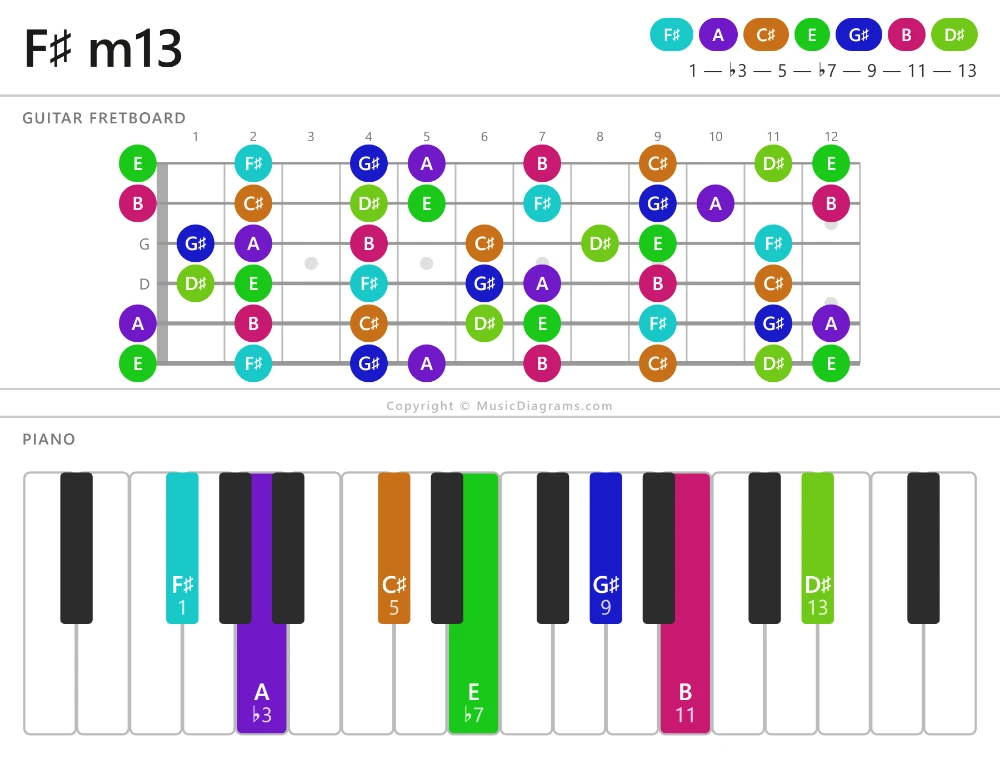
F-sharp minor thirteenth is a Minor chord family sound built from the notes F♯, A, C♯, E, G♯, B, and D♯. Its root is F♯, and its interval number formula is 1-♭3-5-♭7-9-11-13. Those intervals are called the root, minor third, perfect fifth, minor seventh, major ninth, perfect eleventh, and major thirteenth. You may also see it written as F♯m13, F♯ min13, or F♯-13. If you are new to chords, the widget above can help you see how these notes stack together, and learning about the chord intervals makes this large chord much easier to understand.
F♯ m13 Alternate Names
- F♯m13
- F♯ min13
- F♯-13
F♯ m13 Chord Notes
F♯ m13 Chord Formula
F♯ m13 Chord Notation
How To Use F♯ m13 In Music
Because it includes both the basic minor chord tones and several colorful extensions, F♯m13 has a deep, rich, and soulful sound that often feels smooth, jazzy, thoughtful, or slightly dreamy. On its own, it sounds more complex than a simple minor chord, but the mood can change depending on the chords around it. For example, F♯m13 can feel reflective in a progression like i–VI–III–VII in F♯ minor, or it can act as a softer pre-dominant color in a jazz-style movement such as ii–V–I, where F♯m13 might appear as the ii chord in E major before B7 and Emaj7. Next to brighter chords it may sound warm and elegant, while beside darker chords it can feel more mysterious.
F♯ m13 Chord Inversions
Another useful idea is inversion, which means the chord keeps the same notes but a note other than the root is placed in the bass. For F♯m13, a player might use A in the bass for first inversion, C♯ in the bass for second inversion, or E in the bass for third inversion, with other extended tones also sometimes placed underneath in practical voicings. These choices do not change the chord’s name in a basic sense, but they do change its weight, balance, and motion. Inversions can make the chord sound smoother, lighter, or more connected to the next harmony, which is why musicians use them to improve voice leading. If you want a clearer sense of the starting note that defines the chord, this guide to the chord root is helpful.