The F♯ m6 Chord Explained
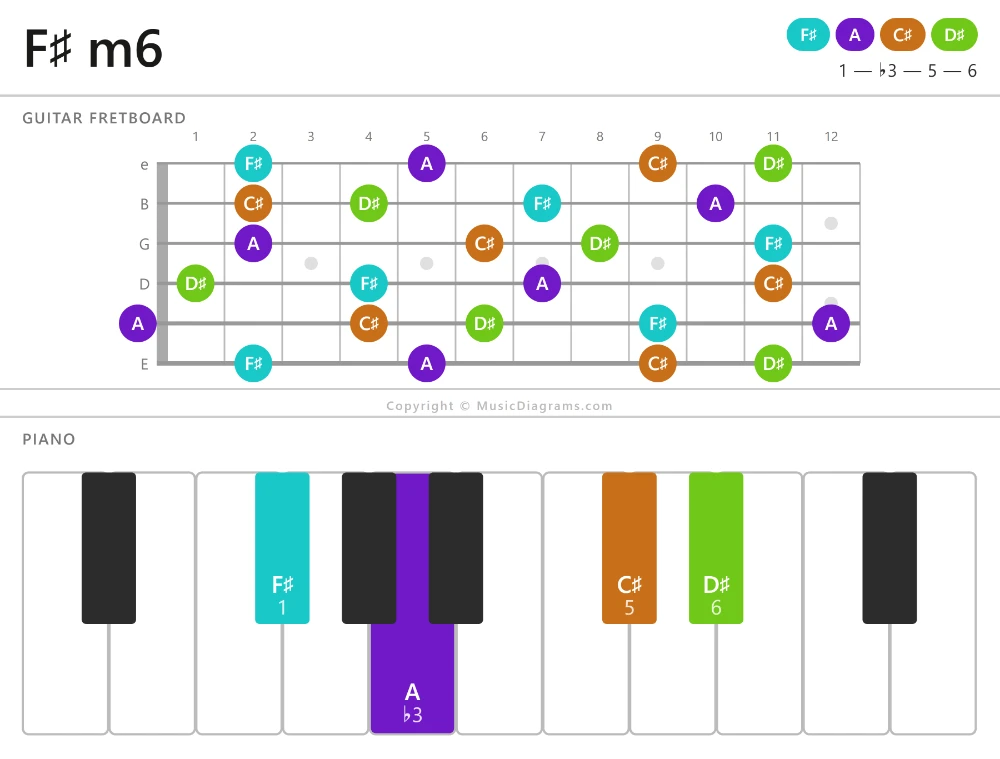
F-sharp minor sixth is a Minor chord family chord built from the notes F♯, A, C♯, and D♯. Its root is F♯, and its interval number formula is 1-♭3-5-6, which gives you the interval names root, minor third, perfect fifth, and major sixth. You may also see it written as F♯m6, F♯ min6, or F♯ minor 6. If you are new to chords, the widget above can help you see and hear how these notes work together, and learning about chord intervals makes this formula much easier to understand.
F♯ m6 Alternate Names
- F♯m6
- F♯ min6
- F♯ minor 6
F♯ m6 Chord Notes
F♯ m6 Chord Formula
F♯ m6 Chord Notation
How To Use F♯ m6 In Music
Often, F-sharp minor sixth has a smooth, slightly wistful sound that feels more colorful than a plain minor chord. It can sound gentle, jazzy, thoughtful, or even quietly dramatic depending on the chords around it. For example, in the key of A major, F♯m6 can act like vi in a progression such as I–vi–ii–V, while in F♯ minor it may be used as a tonic color chord in i–iv–V or i–VI–III–VII. If it moves to brighter chords, it may feel warm and lyrical, but next to darker or more tense harmony it can sound more mysterious. Because its minor quality is softened by the major sixth, it is a useful choice when a songwriter wants something sad but not too heavy, similar in spirit to how a minor chord can change character in context.
F♯ m6 Chord Inversions
Another useful way to play this chord is through inversions, which means using a note other than F♯ as the lowest note. In root position, the notes are F♯-A-C♯-D♯. In 1st inversion, A is in the bass: A-C♯-D♯-F♯. In 2nd inversion, C♯ is in the bass: C♯-D♯-F♯-A. In 3rd inversion, D♯ is in the bass: D♯-F♯-A-C♯. These inversions keep the same chord name and notes, but they can change the weight, flow, and mood of the sound. A root-position shape often feels settled, while inversions can feel lighter, more flowing, or more tense, which is why musicians use them to create smoother bass lines and easier movement between chords.