The F♯ m7♭5 Chord Explained
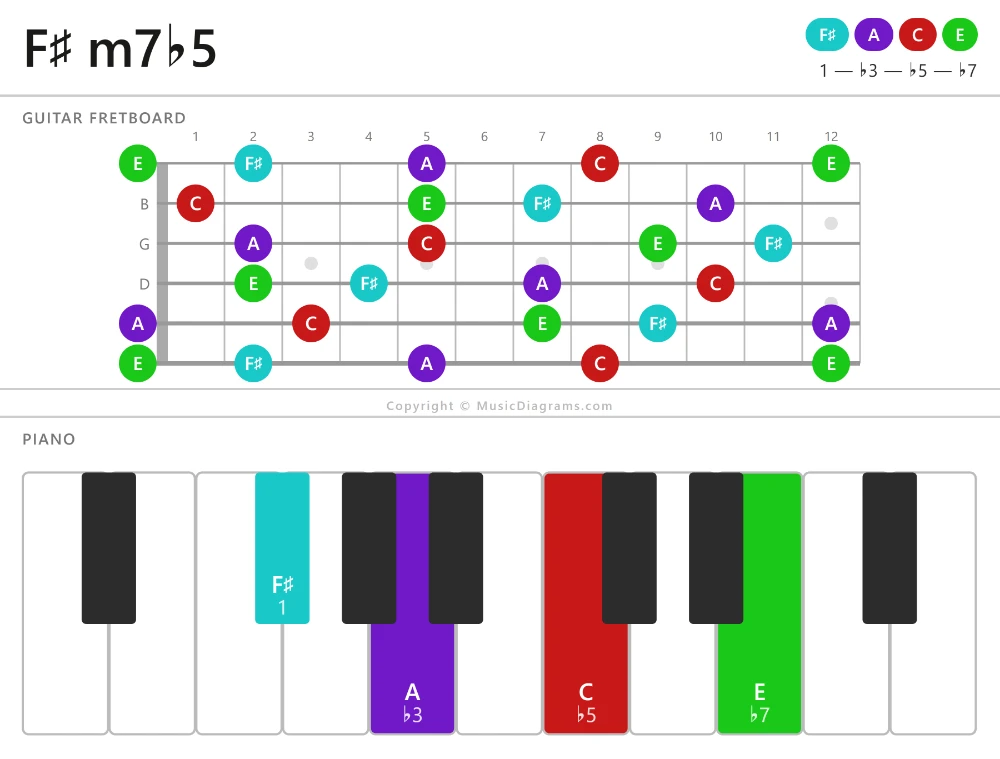
F-sharp minor seven flat five is a Half-Diminished chord built from the notes F♯, A, C, and E. Its root is F♯, and its interval formula is 1-♭3-♭5-♭7, which gives you the interval names root, minor third, diminished fifth, and minor seventh. You may also see it written as F♯m7♭5, F♯ø7, or plain-text spellings such as F-sharp half-diminished seventh. If you look at the widget above, you can match these notes on the piano and guitar diagrams and hear how they combine; this is also a helpful way to begin understanding chord intervals.
F♯ m7♭5 Alternate Names
- F♯m7♭5
- F♯ø7
- F-sharp half-diminished seventh
F♯ m7♭5 Chord Notes
F♯ m7♭5 Chord Formula
F♯ m7♭5 Chord Notation
How To Use F♯ m7♭5 In Music
Because of its lowered fifth and seventh, this chord sounds tense, dark, and slightly unstable, but not as harsh as a fully diminished chord. It is often used to create motion toward a stronger resolving chord, especially in jazz, classical, and cinematic music. In a major key, F♯m7♭5 can appear as viiø7, often leading toward a tonic-related harmony, and in E minor it can work as iiø7 in a progression like iiø7–V–i, where F♯m7♭5 moves to B7 and then Em. You might also hear it in longer motion such as i–iiø7–V–i or viiø7–iii–vi. Its mood depends a lot on the surrounding chords: placed before a resolution it feels dramatic and directional, while used more slowly it can sound mysterious and reflective. To compare its color with a related harmony, see what is a diminished chord.
F♯ m7♭5 Chord Inversions
Another useful idea is inversion, which means the notes stay the same but a note other than the root is placed at the bottom. For F♯m7♭5 in root position, F♯ is the lowest note; in first inversion, A is the bass; in second inversion, C is the bass; and in third inversion, E is the bass. These inversions do not change the chord’s identity, but they do change its sound and feel. Root position usually sounds the most stable and direct, while inversions can sound smoother, softer, or more connected to the chords around them. Musicians use inversions to improve bass-line movement, make transitions between chords easier, and shape the emotional flow of a progression. You may also come across close voicings or more spread-out voicings of the same chord, which can make it feel tighter, darker, lighter, or more open.