The F♯ m7 Chord Explained
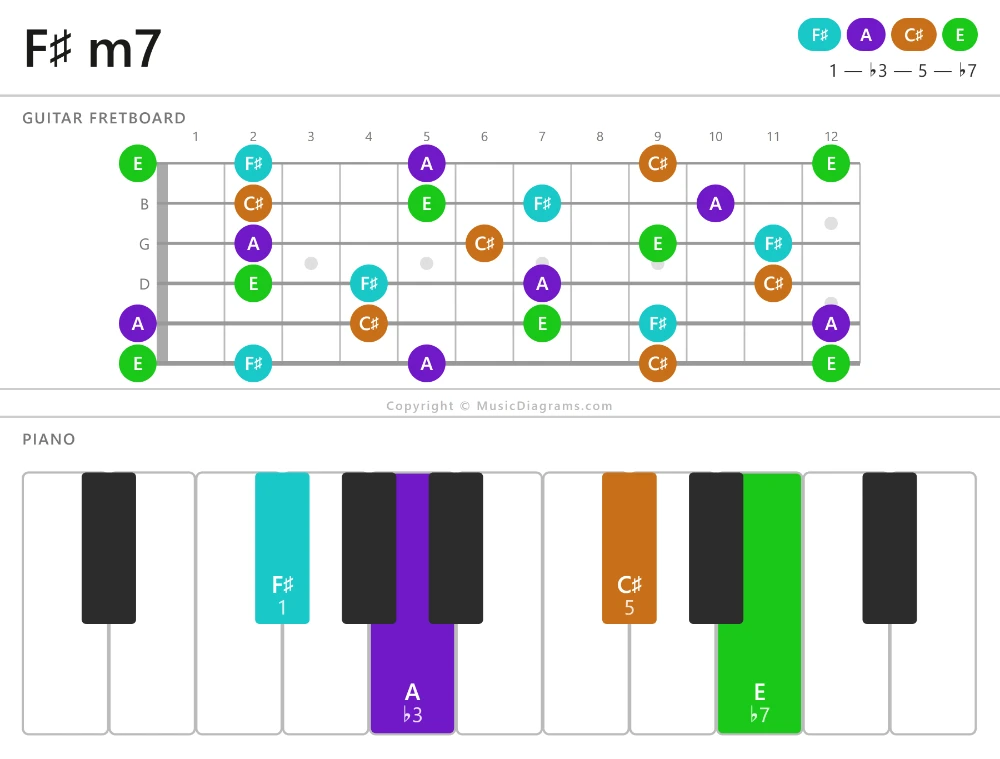
F-sharp minor seventh is a Minor chord family chord built from the notes F♯, A, C♯, and E. Its root is F♯, and its interval number formula is 1-♭3-5-♭7, which gives you the interval names root, minor third, perfect fifth, and minor seventh. You may also see it written as F♯m7, F#m7, or F♯ minor 7. If you look at the widget above, you can see these chord tones laid out clearly on piano and guitar, which is a helpful way to connect the note names to the sound. To learn more about how these distances create the chord, visit chord intervals.
F♯ m7 Alternate Names
- F♯m7
- F#m7
- F♯ minor 7
F♯ m7 Chord Notes
F♯ m7 Chord Formula
F♯ m7 Chord Notation
How To Use F♯ m7 In Music
Often, F♯m7 sounds smooth, warm, reflective, and slightly wistful, making it common in pop, jazz, R&B, soul, and mellow rock. Because it includes the minor seventh, it feels softer and more colorful than a basic minor triad, so it can add depth without sounding too tense. Its mood can shift depending on the surrounding harmony: moving from F♯m7 to A major may feel uplifting, while hearing F♯m7 before E major can feel gentle and unresolved. In the key of E major, it often appears as ii in progressions like ii-V-I, while in A major it can function as vi in patterns such as I-IV-vi-V. If you are new to harmony, it also helps to compare this sound with a plain minor chord so you can hear what the added seventh changes.
F♯ m7 Chord Inversions
Another useful idea is inversion, which means the same chord tones are rearranged so a note other than the root is the lowest pitch. For F♯m7 in root position, F♯ is the lowest note, but its inversions are first inversion with A in the bass, second inversion with C♯ in the bass, and third inversion with E in the bass. These are still F♯m7 because the notes remain F♯, A, C♯, and E, yet each inversion changes the weight and flow of the chord. An A-in-the-bass version can sound a little softer, C♯ in the bass can feel more open, and E in the bass can create a stronger pull into the next chord. Players use inversions to make progressions smoother, reduce large jumps between chords, and shape the emotional contour of the accompaniment.