The F♯ maj7 Chord Explained
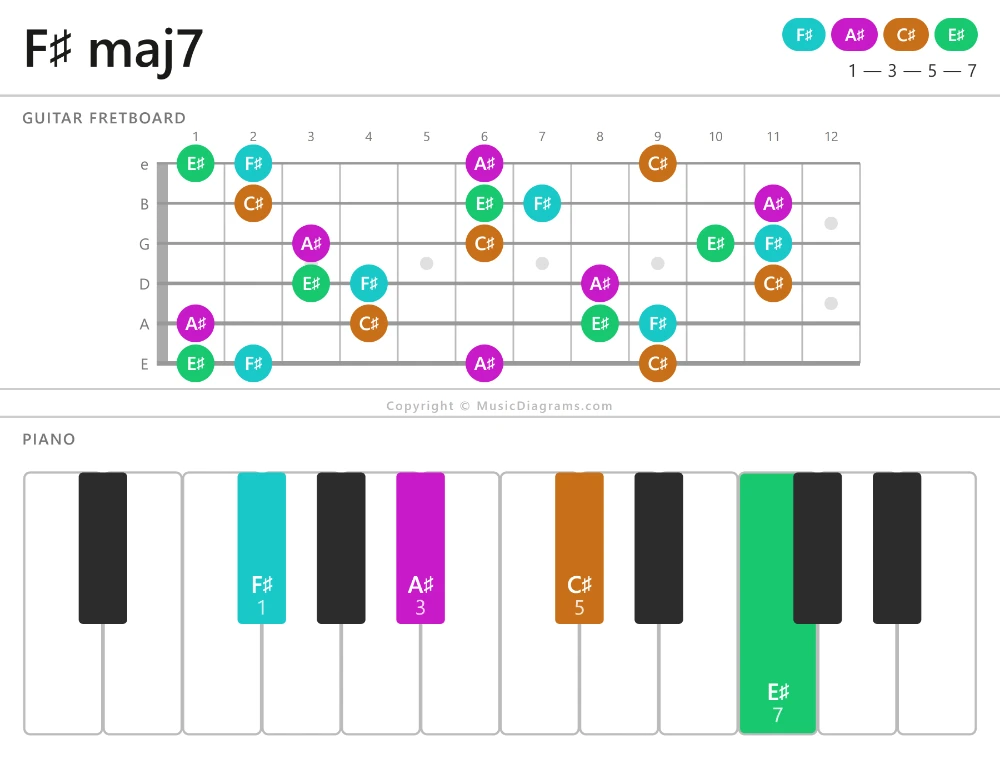
F-sharp major seventh is a Major chord family chord built from the notes F♯, A♯, C♯, and E♯. Its root is F♯, and its interval number formula is 1–3–5–7, which gives you the interval names root, major third, perfect fifth, and major seventh. You may also see it written as F♯maj7, F♯M7, or F♯Δ7, all meaning the same basic chord. If you look at the widget above, you can use the piano and guitar diagrams to visualize how these four notes combine, and hearing the tones can help you connect the sound to the shape. To better understand how these notes are measured from the root, see understanding chord intervals.
F♯ maj7 Alternate Names
- F♯maj7
- F♯M7
- F♯Δ7
F♯ maj7 Chord Notes
F♯ maj7 Chord Formula
F♯ maj7 Chord Notation
How To Use F♯ maj7 In Music
Often described as smooth, warm, dreamy, and polished, the F♯ major seventh chord has a gentle richness that feels more colorful than a plain major chord. Because the major seventh interval adds a soft tension, it can sound jazzy, reflective, romantic, or serene depending on the chords around it. For example, in the key of F♯ major it can appear as I–vi–ii–V with F♯maj7 as the home chord, or in a softer pop or jazz setting you might hear IV–I–V or ii–V–I with F♯maj7 as the resolution. Next to brighter chords it can sound lush and elegant, while after darker chords it can feel comforting and settled. If you want a simple comparison point, a regular major chord sounds more direct and less colorful than a major seventh chord.
F♯ maj7 Chord Inversions
Another useful idea is inversion, which means putting a note other than the root at the bottom. In root position, F♯maj7 is F♯–A♯–C♯–E♯. In first inversion, A♯ is the lowest note: A♯–C♯–E♯–F♯. In second inversion, C♯ is the lowest note: C♯–E♯–F♯–A♯. In third inversion, E♯ is the lowest note: E♯–F♯–A♯–C♯. These inversions keep the same chord quality, but they can change the weight, flow, and mood of the sound. A root-position chord usually feels most stable, while inversions can sound lighter, more flowing, or slightly more tense. Musicians use inversions to create smoother bass lines, connect chords with less movement, and make progressions feel more natural.