The F sus4 Chord Explained
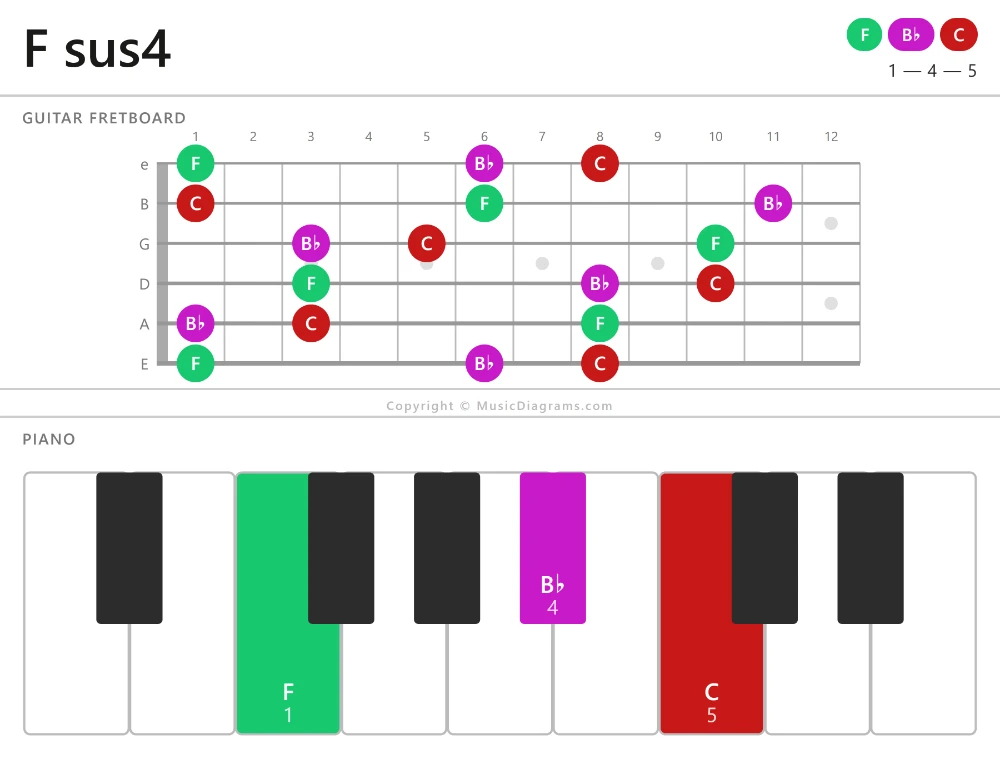
F suspended fourth is a Suspended chord built from the notes F, B♭, and C. Its root is F, and its interval number formula is 1–4–5, which gives you the interval names root, perfect fourth, and perfect fifth. Because the third is replaced by a fourth, this chord does not sound clearly major or minor. You may also see it written as Fsus4, F sus4, or plain-text spelled F suspended fourth. If you want to learn more about how these notes are measured from the root, see chord intervals. The widget above can help you picture these three notes on piano and guitar while you listen to their sound together.

"1-4-5 That's Sus" T-Shirt
Only True Musicians Get This. For musicians in the know. This funny 1-4-5 suspended chord pun shirt is the perfect gift for guitarists, pianists, music teachers, and music nerds.
F sus4 Alternate Names
- Fsus4
- F sus4
- F suspended fourth
F sus4 Chord Notes
F sus4 Chord Formula
F sus4 Chord Notation
How To Use F sus4 In Music
Often, Fsus4 sounds open, expectant, and slightly unresolved, which makes it useful for creating musical tension before a more settled chord arrives. Since it contains F, B♭, and C but no A, it avoids the strong major color of F major and the minor color of F minor, so the mood can feel airy, gentle, dramatic, or even majestic depending on the chords around it. A very common move is Isus4–I in F major, meaning Fsus4 resolving to F major. You might also hear it in progressions like B♭–Isus4–I or Isus4–V–IV, where the suspended sound adds motion and interest. Suspended chords are especially popular in pop, rock, worship, and acoustic styles because they create tension without sounding harsh; you can read more in this guide to suspended chords.
F sus4 Chord Inversions
Another useful idea is inversion, which means playing the same chord tones in a different order so a note other than the root is the lowest pitch. For Fsus4, root position is F–B♭–C, first inversion is B♭–C–F, and second inversion is C–F–B♭. These inversions still contain the same notes, but they can change the weight and feel of the chord. A root-position Fsus4 usually sounds the most stable and grounded, while B♭ in the bass can make it feel softer or more floating, and C in the bass can make it feel more driving or transitional. Players use inversions to create smoother bass lines, connect chords with less movement, and shape the mood of a progression in a more musical way.