The G♭ 11 Chord Explained
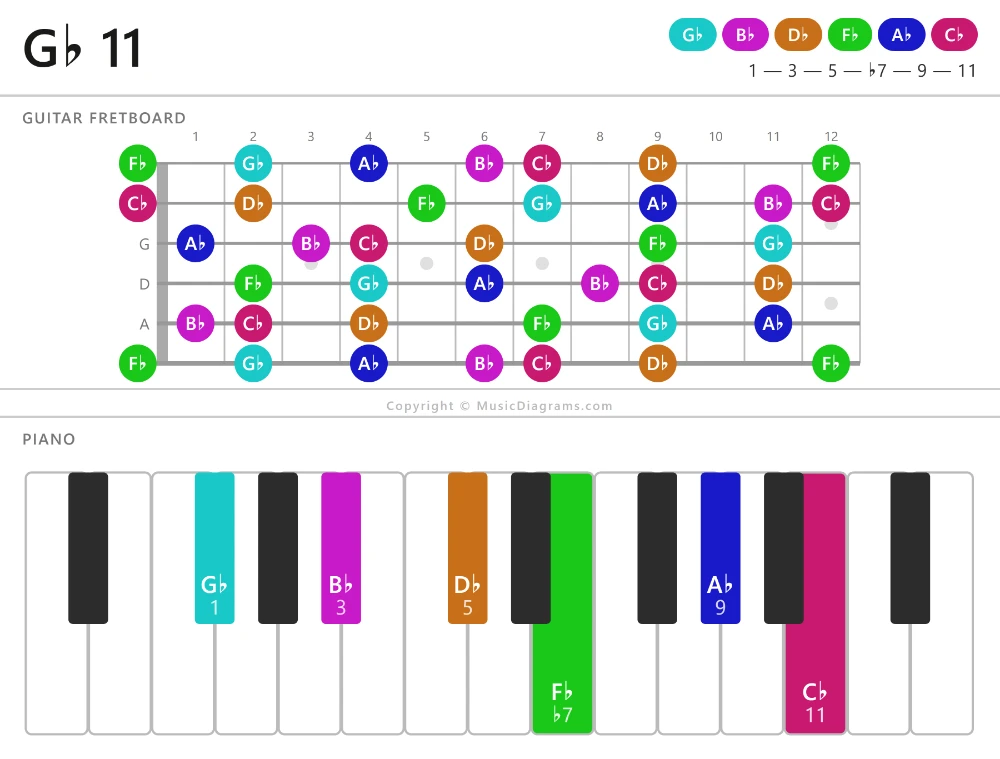
G-flat eleventh is a Dominant chord family chord built from the notes G-flat, B-flat, D-flat, F-flat, A-flat, and C-flat. Its root is G-flat, and its interval number formula is 1–3–5–♭7–9–11, which gives you the interval names root, major third, perfect fifth, minor seventh, major ninth, and perfect eleventh. You may also see it written as G-flat 11, G-flat dominant 11, or G-flat eleventh chord. If you look at the widget above, you can use the piano and guitar diagrams to spot these chord tones and hear how they combine, and you can learn more about chord intervals to understand why this chord has such a rich sound.
G♭ 11 Alternate Names
- G-flat 11
- G-flat dominant 11
- G-flat eleventh
G♭ 11 Chord Notes
G♭ 11 Chord Formula
G♭ 11 Chord Notation
How To Use G♭ 11 In Music
Because it includes both the strong pull of a dominant seventh and the added color of the 9th and 11th, this chord sounds full, tense, and expressive rather than settled. It often creates anticipation and works well when leading to a chord a fifth below, especially in jazz, gospel, funk, and soul. For example, in the key of C-flat major, G-flat11 can act as V in a progression like ii–V–I, moving from D-flat minor to G-flat11 and then to C-flat major. It can also appear in longer movement such as iii–vi–ii–V–I, where the surrounding chords make it feel smoother, brighter, or more dramatic depending on the harmony before and after it. If you want a clearer sense of why dominant-function chords create that forward motion, see what is a dominant chord.
G♭ 11 Chord Inversions
Another useful idea is inversion, which means the chord keeps the same notes but a different note is placed in the bass. For G-flat11, root position has G-flat as the lowest note, while inversions could place B-flat, D-flat, F-flat, A-flat, or C-flat in the bass. A G-flat11 with B-flat in the bass can sound a little lighter and less final, while one with F-flat or C-flat in the bass may sound softer, more suspended, or more fluid in a progression. Players use inversions to make chord changes smoother, create stepwise bass lines, and shape the mood without changing the chord’s basic identity. You may also hear simpler variations in real music, such as leaving out the 5th or spacing the notes differently, especially because large extended chords are often arranged for clarity.