The G♭ 7sus4 Chord Explained
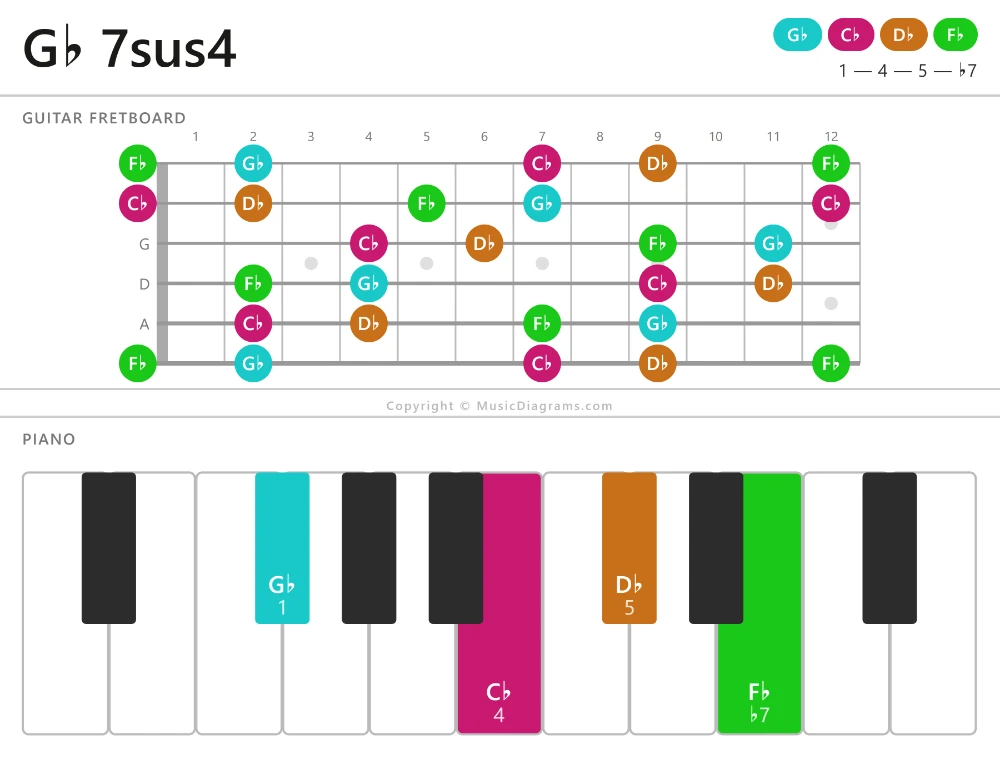
G-flat dominant seventh suspended fourth is a Suspended chord built from the notes G-flat, C-flat, D-flat, and F-flat. Its root is G-flat, and its interval number formula is 1-4-5-♭7, which gives you the interval names root, perfect fourth, perfect fifth, and minor seventh. Because the third is replaced by the fourth, this chord has an open, unresolved sound that is different from a standard seventh chord. You may also see it written as G♭7sus4, G-flat 7sus4, or G-flat dominant seventh sus four. If you want to understand how these chord tones are stacked, the widget above and this guide to chord intervals can help you visualize it clearly.
G♭ 7sus4 Alternate Names
- G♭7sus4
- G-flat 7sus4
- G-flat dominant seventh suspended fourth
G♭ 7sus4 Chord Notes
G♭ 7sus4 Chord Formula
G♭ 7sus4 Chord Notation
How To Use G♭ 7sus4 In Music
Often, this chord sounds tense, spacious, and expectant, as if it is waiting to move somewhere else. That suspended fourth creates a feeling of delay, while the minor seventh adds extra pull, so G♭7sus4 is commonly used before a chord resolution. In progressions, it might function as V7sus4 leading to I, or appear in a gospel, rock, pop, or jazz setting where the suspension adds color before release. For example, in D-flat major you might hear ii–V–I as E♭m–A♭7sus4–D♭, and the same idea can be used with a suspended dominant sound in transposed progressions featuring G♭7sus4. The mood can feel more dramatic or softer depending on the chords around it, especially when it resolves into a major chord or moves through other dominant chord colors.
G♭ 7sus4 Chord Inversions
Another useful idea for beginners is inversion, which means the notes stay the same but a different chord tone is placed in the bass. For G-flat 7sus4, root position has G-flat as the lowest note, while inversions would place C-flat, D-flat, or F-flat in the bass. These changes do not create a brand-new chord quality, but they do change the weight, balance, and flow of the sound. A bass note of C-flat can make the chord feel less grounded, D-flat in the bass can make it sound firmer, and F-flat in the bass can add extra tension before resolution. Musicians use inversions to create smoother bass lines, connect chords more gracefully, and shape the mood of a progression without changing the basic identity of the chord.