The G♭ dim7 Chord Explained
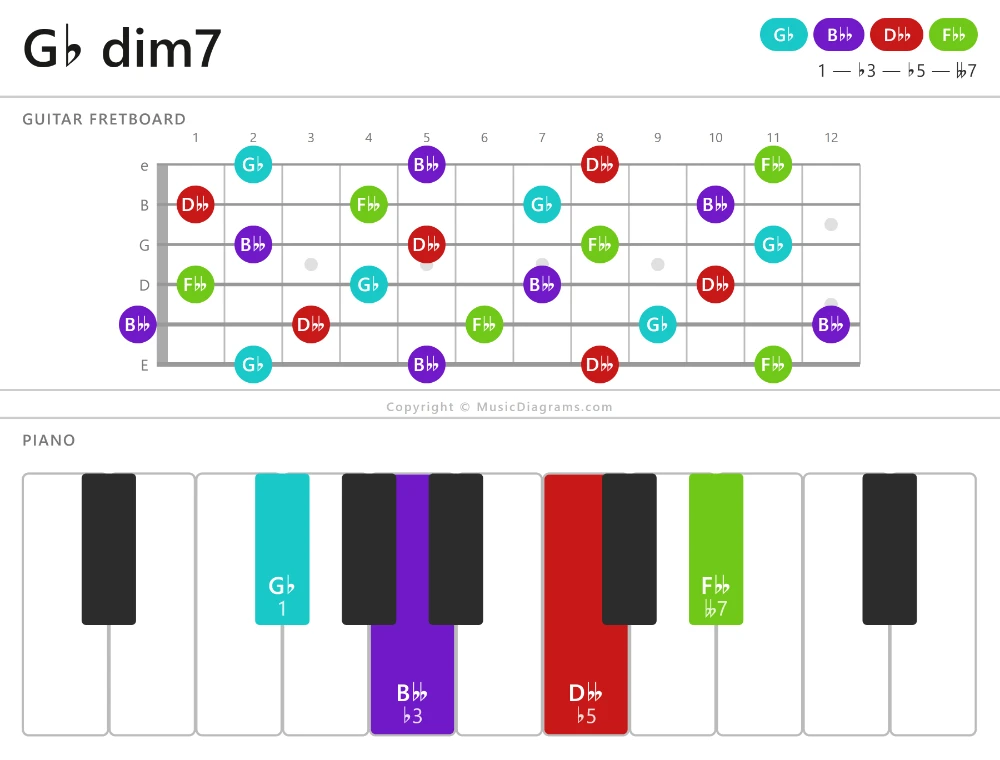
G-flat diminished seventh is a Diminished chord built from the notes G♭, B♭♭, D♭♭, and F♭♭. Its root is G♭, and its interval number formula is 1–♭3–♭5–♭♭7, which gives you the interval names root, minor third, diminished fifth, and diminished seventh. Because every note is stacked in small thirds, this chord has a very tight, tense sound. You may also see it written as G♭dim7, G-flat dim7, or G♭°7. If you look at the widget above, you can match these chord tones on the piano and guitar diagrams, and if you want to learn more about how these distances work, see chord intervals.
G♭ dim7 Alternate Names
- G♭dim7
- G♭°7
- G-flat dim7
G♭ dim7 Chord Notes
G♭ dim7 Chord Formula
G♭ dim7 Chord Notation
How To Use G♭ dim7 In Music
Because this chord is built entirely from tense intervals, it sounds dramatic, unstable, and suspenseful. It often creates a feeling that something needs to resolve, which makes it useful in classical, jazz, film, and pop music when a songwriter wants extra pull into the next chord. For example, G♭dim7 might move to A minor or A-flat minor as a leading diminished chord, or it may appear between more stable harmonies as a passing chord. In a progression, you could hear something like i–#i°7–ii–V in F minor, or vii°7–i when the diminished seventh chord leads strongly into the tonic. The mood can feel darker or sharper depending on whether the surrounding chords are major, minor, or even a dominant chord that increases the need for resolution.
G♭ dim7 Chord Inversions
Another helpful idea for beginners is inversion, which means rearranging the chord so a note other than the root is the lowest pitch. For G-flat diminished seventh, root position has G♭ on the bottom, while inversions place B♭♭, D♭♭, or F♭♭ in the bass. These can be called first inversion, second inversion, and third inversion. Even though the notes stay the same, each inversion changes the weight and flow of the chord, making it sound smoother, more urgent, or better connected to the chord before or after it. Musicians use inversions to create easier bass lines, smoother voice leading, and more natural movement in progressions. Since diminished seventh chords are symmetrical, their inversions also share a closely related sound, which makes them especially flexible in music.