The G♭ sus2 Chord Explained
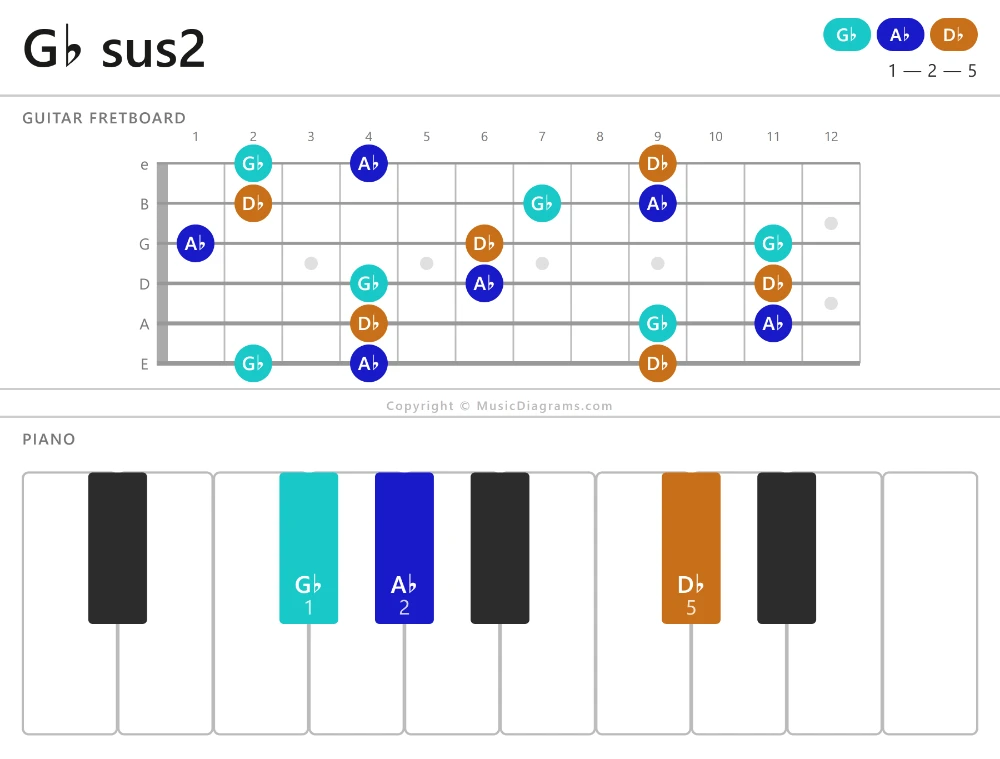
G-flat suspended second is a Suspended chord built from the notes G-flat, A-flat, and D-flat. Its root is G-flat, and its interval number formula is 1-2-5. Those intervals are called the root, major second, and perfect fifth. You may also see this chord written as G-flat sus2, G-flat suspended 2nd, or G-flat add2(no3). Because it replaces the third with the second, the chord sounds open and unresolved, and the widget above can help you see and hear how those three notes fit together. If you are new to chord intervals, this chord is a great example of how changing one note changes the whole character.

"1-4-5 That's Sus" T-Shirt
Only True Musicians Get This. For musicians in the know. This funny 1-4-5 suspended chord pun shirt is the perfect gift for guitarists, pianists, music teachers, and music nerds.
G♭ sus2 Alternate Names
- G-flat sus2
- G-flat suspended 2nd
- G-flat add2(no3)
G♭ sus2 Chord Notes
G♭ sus2 Chord Formula
G♭ sus2 Chord Notation
How To Use G♭ sus2 In Music
Often, G-flat sus2 has a calm, spacious, and slightly floating sound, which makes it useful when you want music to feel gentle, modern, or expectant. Since it does not include the third, it does not sound clearly major or minor, so the chords around it strongly shape how we hear it. For example, moving from G-flat sus2 to G-flat major can feel like a release, while placing G-flat sus2 before D-flat major can sound smooth and lyrical. In Roman-numeral terms, it might appear as Isus2–I in G-flat major, or as IVsus2–V–I in D-flat major. It can also work in progressions such as vi–Isus2–V or Isus2–IV–V, where its suspended quality adds motion without sounding harsh. To better understand how that suspended feeling differs from a standard major sound, compare it with a suspended chord approach in other keys.
G♭ sus2 Chord Inversions
Another useful idea is inversion, which means the same notes are played in a different order so that a note other than the root is the lowest pitch. For G-flat sus2 in root position, G-flat is the lowest note: G-flat–A-flat–D-flat. In first inversion, A-flat is the lowest note: A-flat–D-flat–G-flat. In second inversion, D-flat is the lowest note: D-flat–G-flat–A-flat. These inversions keep the same chord identity, but they can change the feel. A root-position version usually sounds the most stable, while inversions can sound lighter, smoother, or more connected to the chord before or after it. Players often use inversions to make chord changes easier, create a better bass line, or give a progression a different emotional color without changing the basic harmony.