The G maj9 Chord Explained
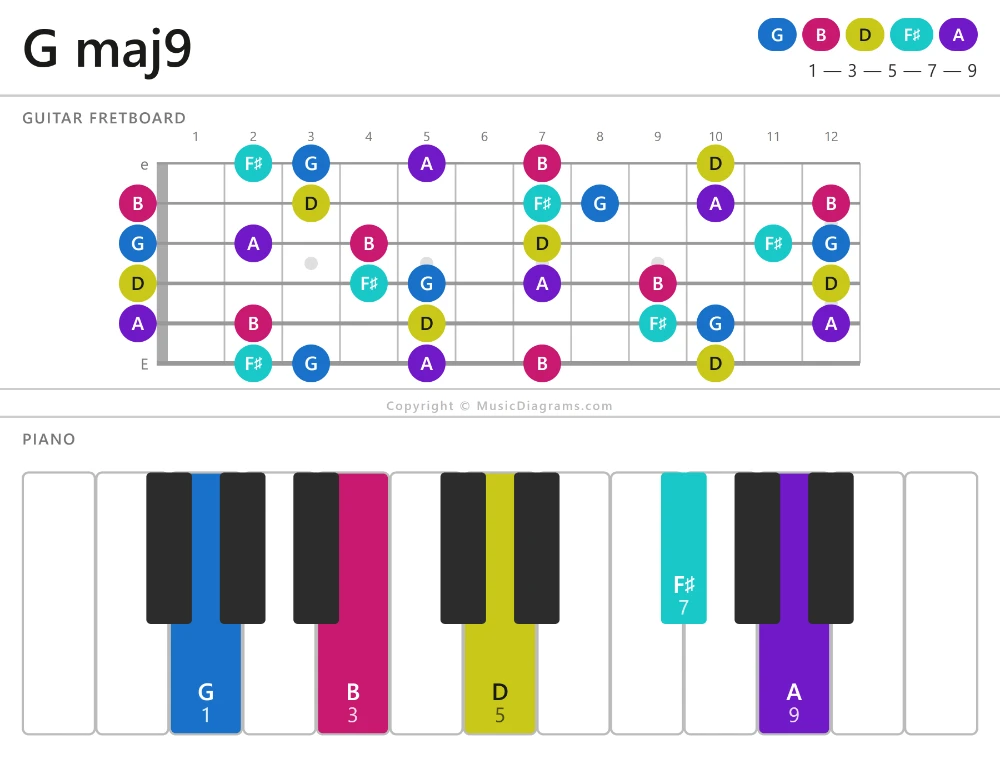
G major ninth is a Major chord family color chord built from the notes G, B, D, F♯, and A. Its root is G, and its interval number formula is 1–3–5–7–9. Those intervals are called root, major third, perfect fifth, major seventh, and major ninth. You may also see it written as Gmaj9, GM9, or GΔ9, all meaning the same basic chord sound. If you look at the widget above, you can match these chord tones on piano or guitar and hear how the added 9th gives the chord a richer sound than a plain major chord. If you are new to this idea, learning chord intervals can make the formula much easier to understand.
G maj9 Alternate Names
- Gmaj9
- GM9
- GΔ9
G maj9 Chord Notes
G maj9 Chord Formula
G maj9 Chord Notation
How To Use G maj9 In Music
Because G maj9 combines the brightness of a major chord with the smooth color of the 7th and 9th, it often sounds warm, polished, dreamy, and slightly jazzy. It can feel peaceful in a ballad, elegant in jazz, or spacious in pop and soul. Its mood also depends on the chords around it: after ii and V chords, I = Gmaj9 can sound settled in a ii–V–I progression such as Am7–D7–Gmaj9; in a gentler pop setting, it might appear as I–V–vi–IV, like Gmaj9–D–Em–C. When used beside simpler major or minor chords, the chord can stand out as more colorful, while next to other extended chords it blends into a smooth, sophisticated texture. For a helpful comparison with its simpler base sound, see what is a major chord.
G maj9 Chord Inversions
Inversions happen when a note other than the root is placed at the bottom of the chord. For G maj9, root position has G as the lowest note, while inversions could place B, D, F♯, or A in the bass. For example, Gmaj9/B can sound lighter and more flowing, while Gmaj9/F♯ can sound especially smooth when moving step by step to another chord. Players use inversions to create better voice leading, make bass lines more melodic, or soften the strong sense of the root. Variations related to this chord can also include simpler forms such as Gmaj7 or fuller voicings that leave out one note for easier playing, while still keeping the major ninth character.