The G♯ Major Chord Explained
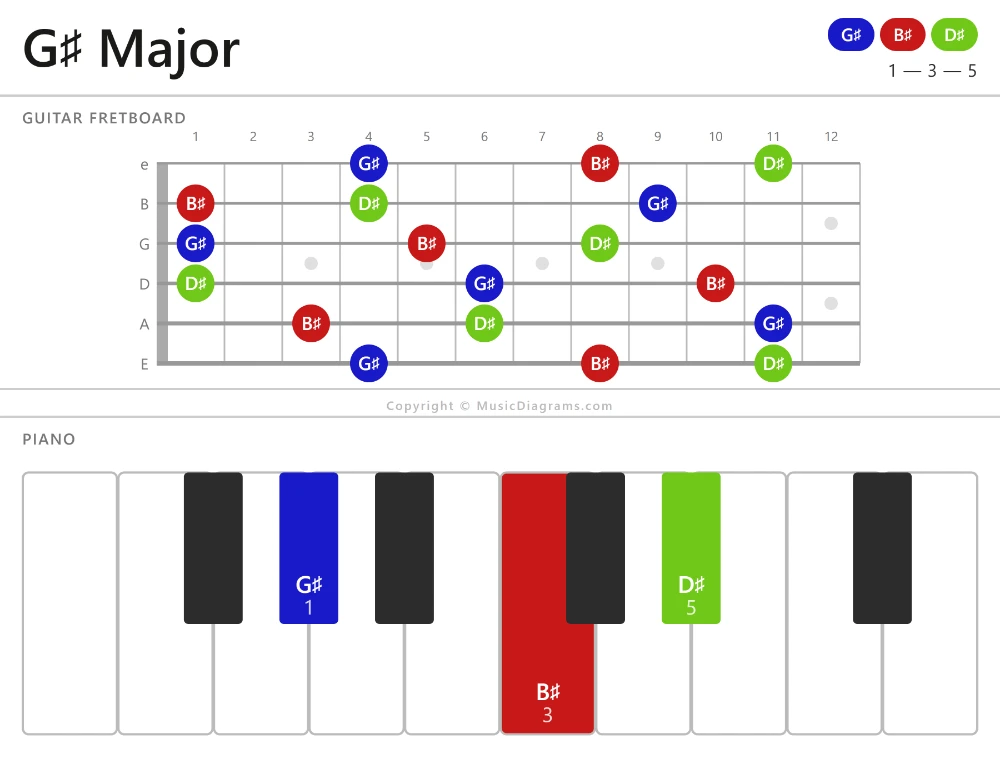
G-sharp major is a Major chord built from the notes G♯, B♯, and D♯. Its root is G♯, and its interval number formula is 1–3–5, which gives you the interval names root, major third, and perfect fifth. This bright, stable chord belongs to the Major family, and you may also see it written as G♯ major, G♯, or plain-text spelling G-sharp major. If you look at the widget above, you can use the piano and guitar diagrams to visualize how these three notes form the chord, and the tones can help you hear how the intervals work together. If you are new to chord structure, this guide to chord intervals can make the formula even easier to understand.
G♯ Major Alternate Names
- G♯
- G♯ major
- G-sharp major
G♯ Major Chord Notes
G♯ Major Chord Formula
G♯ Major Chord Notation
How To Use G♯ Major In Music
Because it is a major chord, G♯ major usually sounds bright, confident, and settled, though its exact mood depends on the chords around it. On its own, it can feel clear and uplifting, but in a progression it may sound more dramatic, warm, or tense depending on context. For example, in the key of C♯ major, G♯ major functions as the V chord, so a progression like I–IV–V–I can create a strong sense of pull back home. You might also hear it in patterns such as ii–V–I or I–vi–IV–V, where its role helps shape momentum and resolution. In some styles, the chord can sound especially powerful before a return to the tonic, much like other major chords that bring brightness and stability to a song.
G♯ Major Chord Inversions
Another useful idea for beginners is inversion, which means rearranging the chord so a note other than the root is the lowest note. In root position, G♯ major is G♯–B♯–D♯. In first inversion, it becomes B♯–D♯–G♯, and in second inversion, it becomes D♯–G♯–B♯. These are still the same chord, but they can change the sound and feel smoother between nearby chords. First inversion often sounds a little lighter or softer, while second inversion can feel more open or less final. Songwriters and arrangers use inversions to make bass lines flow better, reduce large jumps between chords, and create different colors without changing the basic harmony.